Monday, March 28, 2011
"The Montreal Prize" is created
"And the sun pours down like honey / On our lady of the harbour.*" The Globe and Mail reported today that the Montreal Prize has been created. Touted as the “World’s Largest Poetry Competition,” the prize will award $50,000 for a single poem of up to 40 lines written in English by any poet around the world, already published or not. This year, the prize money was donated anonymously; future years will require a sponsor, says Peter Abramowicz, one of the Prize’s three founders (with Len Epp and Asa Boxer). Oh, and this year's judge is Andrew Motion. Whew! Exciting! * I know, I know. Unoriginal. I just couldn't help it. But hey, there's a good discussion question - what's your favourite line of poetry about the city of Montreal?

Wednesday, March 23, 2011
Exploring other roles
So, yes, in the midst of change, there is, um, more change.
It's spring, thank goodness! I only have four more weeks of class (and am beginning to realise how much I will miss this crop of kids)! I am able to run a little without crying over my kneecap! There's light at the end of the tunnel!
.... and I will be exploring new roles (temporarily) at the Ottawa Public Library!
OK, I am going to stop with the exclamation points now.
Starting at the end of this week, I will be acting as Coordinator of Diversity and Accessibility Services for the next few months. This centralised service department includes adult literacy, services to new Canadians, disabled and homebound patrons, and the bookmobile.
This position will take me away from Rideau Branch for the next little while, temporarily. I am conflicted in many ways about leaving a community I have so enjoyed serving, but I know I will return, and I also know that some of the programs I have initiated in my time there will continue to thrive without me, thanks to the rest of the wonderful team there. I am also excited to try a new challenge, see some library services and programs with fresh eyes, and contribute to my library in a different way.
So, can you smell spring in the air? I can!
It's spring, thank goodness! I only have four more weeks of class (and am beginning to realise how much I will miss this crop of kids)! I am able to run a little without crying over my kneecap! There's light at the end of the tunnel!
.... and I will be exploring new roles (temporarily) at the Ottawa Public Library!
OK, I am going to stop with the exclamation points now.
Starting at the end of this week, I will be acting as Coordinator of Diversity and Accessibility Services for the next few months. This centralised service department includes adult literacy, services to new Canadians, disabled and homebound patrons, and the bookmobile.
This position will take me away from Rideau Branch for the next little while, temporarily. I am conflicted in many ways about leaving a community I have so enjoyed serving, but I know I will return, and I also know that some of the programs I have initiated in my time there will continue to thrive without me, thanks to the rest of the wonderful team there. I am also excited to try a new challenge, see some library services and programs with fresh eyes, and contribute to my library in a different way.
So, can you smell spring in the air? I can!
Tuesday, March 22, 2011
new Lisa Lutz!
I was exploring websites relating to fiction genres for the online course I am developing for Algonquin College this summer, and I came across an upcoming Lisa Lutz title I hadn't heard about (thanks to Stop, you're killing me for the link, and for graciously allowing my future students to explore their site).
Entitled Heads you lose, the book is co-authored by Lutz's ex-boyfriend, David Hayward.
Really, the best thing you can do to find out more is to watch this. Cuteness!
Entitled Heads you lose, the book is co-authored by Lutz's ex-boyfriend, David Hayward.
Really, the best thing you can do to find out more is to watch this. Cuteness!
Sunday, March 20, 2011
On (not) running
Well, it's 1ish on a Sunday afternoon and I am still in my pyjamas! Bliss! I will now subject you to an annoyingly non-bookish post. Sorry about that.
The pace of the past few weeks has been especially punishing, pushed over the edge of what is humanly possible by physiotherapy, as alluded to earlier. So what's the deal with me? Basically, I fell up the stairs (as I keep saying, "better than down!") at work in January, catching my kneecap on the metal edge of our staircase. I know knee injuries can be especially complicated and stubborn, but I am still kind of amazed that two and a half months later, my knee is still swollen. The pain has gone down a fair bit, mind you, so that's good.
The biggest stressor in all this (well, besides dashing off to physio, fighting with WSIB, and icing the 'cap every night) has been NOT RUNNING. At all. I have never, ever, taken the ability to run for granted; I have always been actively grateful for the fact that I am able to push my body to new limits. Not to belabour the point, but I did grow up with one parent frequently short of breath. I treasure the fact that I am healthy, and, overall, I still am. But the knee thing has scared me a fair bit, if I am honest (as in, awake in the middle of the night in a panic); not only does it remind me how fragile health can be, but it also reminds me how much I rely on running as an outlet for releasing stress and generally improving my mood. I don't have a lot of hobbies; it's pretty much reading and running. Without one, I am feeling a bit bereft (others might add depressed, lazy, especially needy and generally ill-tempered).
There is light at the end of the tunnel, though: on the advice of my slightly-blasé GP, I did attempt a short 4k run yesterday, to Library and Archives and back. I conscientiously walked all the hills, and anytime I felt a twinge of knee pain. It mostly felt like I had a bruise, and not like my kneecap was going to pop off (which is how it felt the only other time I attempted running since the fall).
I can't tell you how great it felt. Some of you are runners, and you know what I mean. I feel a bit like the last two and a half months were in a fog of endorphin withdrawal; I was slightly tired all the time, but in a weary-but-restless kind of way.
Here's to getting back on track, especially for a very special event in May. More news of a non-knee-related nature tomorrow; there have been other interesting developments to shake things up recently!
The pace of the past few weeks has been especially punishing, pushed over the edge of what is humanly possible by physiotherapy, as alluded to earlier. So what's the deal with me? Basically, I fell up the stairs (as I keep saying, "better than down!") at work in January, catching my kneecap on the metal edge of our staircase. I know knee injuries can be especially complicated and stubborn, but I am still kind of amazed that two and a half months later, my knee is still swollen. The pain has gone down a fair bit, mind you, so that's good.
The biggest stressor in all this (well, besides dashing off to physio, fighting with WSIB, and icing the 'cap every night) has been NOT RUNNING. At all. I have never, ever, taken the ability to run for granted; I have always been actively grateful for the fact that I am able to push my body to new limits. Not to belabour the point, but I did grow up with one parent frequently short of breath. I treasure the fact that I am healthy, and, overall, I still am. But the knee thing has scared me a fair bit, if I am honest (as in, awake in the middle of the night in a panic); not only does it remind me how fragile health can be, but it also reminds me how much I rely on running as an outlet for releasing stress and generally improving my mood. I don't have a lot of hobbies; it's pretty much reading and running. Without one, I am feeling a bit bereft (others might add depressed, lazy, especially needy and generally ill-tempered).
There is light at the end of the tunnel, though: on the advice of my slightly-blasé GP, I did attempt a short 4k run yesterday, to Library and Archives and back. I conscientiously walked all the hills, and anytime I felt a twinge of knee pain. It mostly felt like I had a bruise, and not like my kneecap was going to pop off (which is how it felt the only other time I attempted running since the fall).
I can't tell you how great it felt. Some of you are runners, and you know what I mean. I feel a bit like the last two and a half months were in a fog of endorphin withdrawal; I was slightly tired all the time, but in a weary-but-restless kind of way.
Here's to getting back on track, especially for a very special event in May. More news of a non-knee-related nature tomorrow; there have been other interesting developments to shake things up recently!
Wednesday, March 16, 2011
ah, March Break
Yes, I have been posting short and sweet notes to you all this week because I am particularly swamped at work. It's that time of year, when you frantically construct paper cranes on your lunch hour....

P.S. My lunch-time book, in case you were wondering, is Only the Good Spy Young by Ally Carter.
P.P.S. In Grade 8, I went through a paper crane obsessed phase. It involved making millions of cranes, especially from watermelon Jolly Rancher wrappers. I'm not as good as I used to be....

P.S. My lunch-time book, in case you were wondering, is Only the Good Spy Young by Ally Carter.
P.P.S. In Grade 8, I went through a paper crane obsessed phase. It involved making millions of cranes, especially from watermelon Jolly Rancher wrappers. I'm not as good as I used to be....
Orange Prize longlist announced
... Find it here, with two Canadians on the list: Kathleen Winter for Annabel and Emma Donoghue (listed by the Orange as Irish) for Room.
The Guardian observes that "debut novelists will make up nearly half of the Orange prize for fiction longlist, which this year tackles strikingly difficult subjects: incest, sadistic cruelty, polygamy, child bereavement, hermaphroditism and mental illness."
This list always comes out right after I finish judging BOYCA (check!), and am usually on an adult fiction binge (check!), so I think I will go order some of these right now.
Currently reading: Hand me down world by Lloyd Jones - interestingly constructed novel that portrays one woman's cross-continent search for her son through the eyes of the people she meets along the way.
Finished since last blog post: Major Pettigrew's last stand by Helen Simonson, and Holy fools by Joanne Harris.
The Guardian observes that "debut novelists will make up nearly half of the Orange prize for fiction longlist, which this year tackles strikingly difficult subjects: incest, sadistic cruelty, polygamy, child bereavement, hermaphroditism and mental illness."
This list always comes out right after I finish judging BOYCA (check!), and am usually on an adult fiction binge (check!), so I think I will go order some of these right now.
Currently reading: Hand me down world by Lloyd Jones - interestingly constructed novel that portrays one woman's cross-continent search for her son through the eyes of the people she meets along the way.
Finished since last blog post: Major Pettigrew's last stand by Helen Simonson, and Holy fools by Joanne Harris.
Friday, March 11, 2011
Independent Foreign Fiction Prize 2011 Longlist
Jenny Erpenbeck, Visitation (translated from the German)
Marcelo Figueras, Kamchatka (translated from Spanish)
David Grossman, To the End of the Land (translated from Hebrew)
Daniel Kehlmann, Fame (translated from the German)
Véronique Olmi, Beside the Sea (translated from French)
Orhan Pamuk, The Museum of Innocence (translated from Turkish)
Per Petterson, I Curse the River of Time (translated from the Norwegian)
Santiago Roncagliolo, Red April (translated from Spanish)
Jachym Topol, Gargling with Tar (translated from Czech)
Alberto Berrera Tyszka, The Sickness (translated from Spanish)
Juan Gabriel Vásquez, The Secret History of Costaguana (translated from Spanish)
Per Wästberg, The Journey of Anders Sparrman (translated from Swedish)
Michal Witkowski, Lovetown (translated from Polish)
Shuichi Yoshida, Villain (translated from the Japanese)
Juli Zeh, Dark Matter (translated from the German)
Details here.
Marcelo Figueras, Kamchatka (translated from Spanish)
David Grossman, To the End of the Land (translated from Hebrew)
Daniel Kehlmann, Fame (translated from the German)
Véronique Olmi, Beside the Sea (translated from French)
Orhan Pamuk, The Museum of Innocence (translated from Turkish)
Per Petterson, I Curse the River of Time (translated from the Norwegian)
Santiago Roncagliolo, Red April (translated from Spanish)
Jachym Topol, Gargling with Tar (translated from Czech)
Alberto Berrera Tyszka, The Sickness (translated from Spanish)
Juan Gabriel Vásquez, The Secret History of Costaguana (translated from Spanish)
Per Wästberg, The Journey of Anders Sparrman (translated from Swedish)
Michal Witkowski, Lovetown (translated from Polish)
Shuichi Yoshida, Villain (translated from the Japanese)
Juli Zeh, Dark Matter (translated from the German)
Details here.
Thursday, March 10, 2011
Coming up at Rideau Library...
Monday, March 14, 7 p.m.
 The Firestone Story
The Ottawa Art Gallery is home to the Firestone Collection of Canadian Art. Come and learn about the family and their art collection: who they were, how they lived, why and what they collected. Hosted by the Ottawa Art Gallery.
Presentation in English with bilingual facilitator / Présentation en anglais avec animateur bilingue.

 The Firestone Story
The Ottawa Art Gallery is home to the Firestone Collection of Canadian Art. Come and learn about the family and their art collection: who they were, how they lived, why and what they collected. Hosted by the Ottawa Art Gallery.
Presentation in English with bilingual facilitator / Présentation en anglais avec animateur bilingue.

Emily Carr, Sunlight in the Forest, oil on linen, 1912
Sunday, March 6, 2011
Alex's half-marathon run to support Medic to Medic
 Hi everyone,
I am running the Ottawa Race Weekend half-marathon on May 29, 2011 in support of the work of Medic to Medic.
Medic to Medic was founded by my cousin-in-law, Kate Mandeville, and support trainee health workers who have academic potential, but are in financial need.
The program currently operates in Malawi, and will be expanding to Uganda in September.
If you wish to support my run, please visit this page to make a donation.
Thanks for your support!
-Alex.
 Me, just before last year's half-marathon
Saturday, March 5, 2011
Occassionally, when I am really good, I get to read....
One afternoon earlier this week, I took what felt like a 30 minute vacation and read this Master's paper. When I have some time to read at my desk in the basement, I like to put my feet on the desk. I know, how unseemly! I remember my dad doing this, and chewing on the end of his pen or pencil, in his office in All Saints, Verdun. It's a little thing I can do to channel that.
So, the doc.:
Harvey, Aisha A. Homeless perspectives of the public library. University of North Carolina at Chapel Hill, 2002. Web. 2 March 2011.
What an interesting paper: Harvey rightly points out that "While hardly any homeless people are asked about their perceptions of libraries many librarians are asked about homeless patrons," and her paper takes one step towards remedying that situation. Harvey conducted five interviews with homeless individuals who visited the Durham Public Library's central branch (located across the street from the Durham Urban Ministries homeless shelter); the five participants' personalities jumped off the page, alternatively moving me to laughter and (honestly) tears. Harvey paid the participants $10 each as an honorarium; one gentleman "folded the ten-dollar bill five times before placing it in his shoe."
I would highly recommend this study to anyone interested in use of libraries by homeless populations in an urban/suburban area. Here are some other interesting bits (and sorry for the bullet points):
So, the doc.:
Harvey, Aisha A. Homeless perspectives of the public library. University of North Carolina at Chapel Hill, 2002. Web. 2 March 2011.
What an interesting paper: Harvey rightly points out that "While hardly any homeless people are asked about their perceptions of libraries many librarians are asked about homeless patrons," and her paper takes one step towards remedying that situation. Harvey conducted five interviews with homeless individuals who visited the Durham Public Library's central branch (located across the street from the Durham Urban Ministries homeless shelter); the five participants' personalities jumped off the page, alternatively moving me to laughter and (honestly) tears. Harvey paid the participants $10 each as an honorarium; one gentleman "folded the ten-dollar bill five times before placing it in his shoe."
I would highly recommend this study to anyone interested in use of libraries by homeless populations in an urban/suburban area. Here are some other interesting bits (and sorry for the bullet points):
- "Most of the informants did indicate that they had gone to libraries as children." And later, "There is some evidence that the current relationship that the informants have with the library, stems from positive experiences that they had with the library earlier in their lives. Some of the informants indicated that they had used the library as children."
- Almost all the individuals interviewed were really pleased with library services and the interactions they had with staff. One individual had a bit more of a colourful experience to report, and although some of his comments could probably be taken with a grain of salt, one phrase struck me as being pretty accurate: he said "Well basically, I wish they would get a GED class going over there, something to help people. It would be useful. Like classes to help people learn to get their GED or whatever. Basically, you are helping yourself. I don’t see any activities they are doing over there to try and help anybody."
- That being said, "from the informants’ responses, it can be concluded that most of them believe that they welcome at this public library. This feeling of acceptance encourages them to ask for help when they need something and can play a power role of encouragement and support in their lives."
- "It is interesting to note that all of the informants except for Informant #5 went to the library either every day or more days out of the week than they did not." That absolutely holds true with the experiences I have had, as well.
- Again, something I have heard patrons say: "Some informants indicated that presently the library was also used to combat drug use. While most of the informants said that the library collection held nothing to help them stay clean, some informants said that because the library is free from the pressure to use drugs that they encountered on the streets, that it was an agent of sobriety in their lives."
- "All of the informants said that they read in the library. [...] Most of the informants use the library to gain knowledge of many topics. In many ways, the library may appeal to the informants more than the classroom as a learning environment."
Friday, March 4, 2011
We'll miss you, May.
A mere four days before International Women's Day, we've lost a wonderful role model. Former Westmount mayor and founder of Tundra Books, May Cutler, has died.
By the time I began working at Westmount Library in 1998, May was no longer mayor, but she was a frequent visitor, honoured guest at events, and a regular Reference desk patron. I hope those who know May far better than me will forgive me my scant remembrances.
May was a force to be reckoned with, and she was never short of opinions! She was unfailingly charming and passionate about new ideas, of which she always had many: some of the things she inquired about when I was working Reference were so interesting that I had to read about them after she left, and many of her ideas were years ahead of the game. If memory serves me, she was one of the vocal advocates for the inclusion of a large children's department in the plans for the 1994-5 renovation of the Westmount Library; this department, as some of you well know, now flourishes as a a true home for imagination and a place of wonderful personal service (not to mention whimsical parties!)
At Tundra, of course, she worked with greats such as Carrier and Kurelek, C. J. Taylor and Bonnie Shemie, and she helped "discover" and support the work of Dayal Kaur Khalsa.
I only hope I'm on a six week trip to Antarctica at age 86. Well done, May!
By the time I began working at Westmount Library in 1998, May was no longer mayor, but she was a frequent visitor, honoured guest at events, and a regular Reference desk patron. I hope those who know May far better than me will forgive me my scant remembrances.
May was a force to be reckoned with, and she was never short of opinions! She was unfailingly charming and passionate about new ideas, of which she always had many: some of the things she inquired about when I was working Reference were so interesting that I had to read about them after she left, and many of her ideas were years ahead of the game. If memory serves me, she was one of the vocal advocates for the inclusion of a large children's department in the plans for the 1994-5 renovation of the Westmount Library; this department, as some of you well know, now flourishes as a a true home for imagination and a place of wonderful personal service (not to mention whimsical parties!)
At Tundra, of course, she worked with greats such as Carrier and Kurelek, C. J. Taylor and Bonnie Shemie, and she helped "discover" and support the work of Dayal Kaur Khalsa.
I only hope I'm on a six week trip to Antarctica at age 86. Well done, May!
Tuesday, March 1, 2011
Things read during recent stolen moments!
I know, my pretties. You missed me, right?
The past few weeks have flown by, a crazy muddle of various things, including Reading week at the college, some massive promo for some library programs (art, gardening, legal aid), a Freedom to read week event for LANCR that was great, but also kind of a comedy of errors, two conference calls for the BOYCA shortlist (announced today!), a deadline for Algonquin stuff, and some other random things. In addition to all that, I've been swamped with after-work stuff - fear not, I haven't recently developed a glittery social life, it's just cat-sitting and physiotherapy for a knee injury I sustained at work in January. Yeah, you try fitting in 3x physio a week, when you already work two nights a week and teach on one of your mornings off. I'm not complaining; just saying it requires a certain finesse, every spare second of free time, and a long-suffering spouse.
Meanwhile, now that I have been released from the BOYCA reading list for another year, I can go back to reading some adult novels. Here are some things I've had on my living room reading table / in my handbag / on the staffroom table / at physio in the past few weeks:
 Great House by Nicole Krauss: I loved, loved, loved 2005's The History of Love. Great House is less neatly tied together, in terms of plot; The History of Love was full of somewhat unlikely coincidences, and a lot more humour to relieve the tension of some of the heartache. The Washington Post's Ron Charles says Great House "doesn't take [as] many risks" as The History of Love, and thus also "never dazzles us, never sweeps us away. Its beauty is a heavy brocade of grief that won't let these characters soar." I think I agree with him, but I don't think that this is a criticism, per se. I think Great House is just a different kind of book, showing a less perfect set of human relationships. The Telegraph says that Krauss, in this novel, "gives us her tragic vision pure. It is a high-wire performance, only the wire has been replaced by an exposed nerve, and you hold your breath, and she does not fall." I would agree.
The Good Man Jesus and the Scoundrel Christ by Philip Pullman: I confess I mostly read this to see if it was worth recommending to the spouse and his mother-in-law; they enjoy their religious debates, and I thought a myth told by an atheist might be a good discussion starter. This book took me awhile to get the hang of: it is so simply written that I found it rather disarming; the thing is, despite the simplicity of the text, it is a deeply thoughtful examination of truth, fact, mythology, faith, fame and envy. Essentially, Pullman makes Christ and Jesus into two different characters who are brothers. While Jesus is the one with the fan base, Christ records his travels and preachings, embellishing and manipulating the facts of their story to allegedly get at the "truth" of things. I thought this was an interesting idea, but neither character jumped off the page for me, in the end. Read more via the Guardian if you wish.
 Something Missing by Matthew Dicks: File this one under "randoms"; I think it was something I picked up at a Divas talk...? Anyway, it's a strange and thoroughly entertaining story of an professional thief who suffers who begins to feel that he should help the people from whom he steals.... Mayhem ensues, of course. A quick read.
Folly by Marthe Jocelyn: This one was like candy, so easy and fun to read. Technically a YA title, this was at least one reading level up from the, oh 38-odd books I just polished off for BOYCA. On that subject, Folly was shortlisted today for one of the other CLA Book Awards, the Young Adult Book Award. Folly is a richly-detailed historical novel set in Victorian London, and following the plight of a young girl sent into service by her unkind stepmother; before long, she finds herself in London, and in love. For romance-loving teens, or the Upstairs, Downstairs / Downton Abbey crowd.
The Hand That First Held Mine by Maggie O'Farrell: As usual, when this came in, I thought blankly: did it win something? Get shortlisted for something? Looks familiar.... Welcome to my world. Anyway, this novel won the 2010 Costa Novel Award, and you can read an extract here. In the end, this story took awhile to get going, in my opinion; the first half drags a fair bit. The second half, however, is riveting. Essentially, this is the story of another Alexandra (!), known as Lexie (no. Just NO, before you ask...). A young Lexie leaves her stifling Devon home after being sent away from university (in England in the 1950s, for exiting a door marked for men after an examination). She takes up with charismatic magazine editor, Innes Kent, and begins a whirlwind life in Soho. An alternate strand in this story depicts the struggles of Elina, a new mother in modern London, whose partner, Ted, seems to be rather falling apart at the seams; twists and turns in the two women's stories reveal that they are, in fact, linked. An interesting examination of the evolution of women's roles in society, and the impact our childhood has on us as adults.
The Particular Sadness of Lemon Cake by Aimee Bender: Well, this was an odd book, in a kind of wonderful way at first, and then in mostly just a strange way. At age 8, Rose discovers (via her mother's lemon cake) that she can taste the emotions of the person who prepares her food; the lemon cake tastes so overwhelmingly of sadness that Rose is ill. You can imagine how this might pose various problems: for one thing, forget about enjoying a cookie from the local bakery, and also forget about the concept of "too much information" - Rose simply can't stop the insights that come from other people's food, and she learns some disturbing and unwanted things about those around her. In the last 50 or so pages, this book takes a bit of a weird turn, and I wasn't sure I wanted to go there, honestly. I have to say I ended up feeling the same way about this that I do about most sweets: at first I'm all, yeah, fabulous, and then when I take the 3rd bite, I begin to wonder why I'm eating this and what else I would rather have eaten, and then when I put the fork down I pretty much remember why I don't eat sweets a lot: I don't really like most of them. Sorry!
The Birth of Love by Joanna Kavenna: I don't know how I ended up reading so many novels about women who either have children or don't; I guess you could say that's a central choice for female characters of a certain age, but I must say I was beginning to feel a bit stifled by these stories as I put down the last book on this list. This is a bit of a read-alike for The Unit by Ninni Holmqvist.... The Birth of Love weaves together four stories, each pertaining to childbirth and/or the mother-child relationship. One, in the past, details the mental breakdown of a real-life physician, Dr. Ignaz Semmelweis (who discovered that rates of "childbed fever" could be drastically reduced by physicians washing their hands); another follows modern-day mother, Brigid, whose hopes of a home birth are somewhat confounded. Yet another, this time futuristic, storyline consists largely of trial transcripts from a post-apocalyptic England, where several men and women are accused of conspiring against their authoritarian government by protecting a pregnant woman, also named Brigid. Finally, the last storyline involves an anxious writer who attends his own book launch but is plagued by worries for his own ill mother. While I can understand the Guardian's comparison of this book with The Hours, I didn't enjoy it as much as Cunningham's novel. I was drawn to both Brigids (although I found the links between the two strained credibility), but less to the other characters.
The past few weeks have flown by, a crazy muddle of various things, including Reading week at the college, some massive promo for some library programs (art, gardening, legal aid), a Freedom to read week event for LANCR that was great, but also kind of a comedy of errors, two conference calls for the BOYCA shortlist (announced today!), a deadline for Algonquin stuff, and some other random things. In addition to all that, I've been swamped with after-work stuff - fear not, I haven't recently developed a glittery social life, it's just cat-sitting and physiotherapy for a knee injury I sustained at work in January. Yeah, you try fitting in 3x physio a week, when you already work two nights a week and teach on one of your mornings off. I'm not complaining; just saying it requires a certain finesse, every spare second of free time, and a long-suffering spouse.
Meanwhile, now that I have been released from the BOYCA reading list for another year, I can go back to reading some adult novels. Here are some things I've had on my living room reading table / in my handbag / on the staffroom table / at physio in the past few weeks:
 Great House by Nicole Krauss: I loved, loved, loved 2005's The History of Love. Great House is less neatly tied together, in terms of plot; The History of Love was full of somewhat unlikely coincidences, and a lot more humour to relieve the tension of some of the heartache. The Washington Post's Ron Charles says Great House "doesn't take [as] many risks" as The History of Love, and thus also "never dazzles us, never sweeps us away. Its beauty is a heavy brocade of grief that won't let these characters soar." I think I agree with him, but I don't think that this is a criticism, per se. I think Great House is just a different kind of book, showing a less perfect set of human relationships. The Telegraph says that Krauss, in this novel, "gives us her tragic vision pure. It is a high-wire performance, only the wire has been replaced by an exposed nerve, and you hold your breath, and she does not fall." I would agree.
The Good Man Jesus and the Scoundrel Christ by Philip Pullman: I confess I mostly read this to see if it was worth recommending to the spouse and his mother-in-law; they enjoy their religious debates, and I thought a myth told by an atheist might be a good discussion starter. This book took me awhile to get the hang of: it is so simply written that I found it rather disarming; the thing is, despite the simplicity of the text, it is a deeply thoughtful examination of truth, fact, mythology, faith, fame and envy. Essentially, Pullman makes Christ and Jesus into two different characters who are brothers. While Jesus is the one with the fan base, Christ records his travels and preachings, embellishing and manipulating the facts of their story to allegedly get at the "truth" of things. I thought this was an interesting idea, but neither character jumped off the page for me, in the end. Read more via the Guardian if you wish.
 Something Missing by Matthew Dicks: File this one under "randoms"; I think it was something I picked up at a Divas talk...? Anyway, it's a strange and thoroughly entertaining story of an professional thief who suffers who begins to feel that he should help the people from whom he steals.... Mayhem ensues, of course. A quick read.
Folly by Marthe Jocelyn: This one was like candy, so easy and fun to read. Technically a YA title, this was at least one reading level up from the, oh 38-odd books I just polished off for BOYCA. On that subject, Folly was shortlisted today for one of the other CLA Book Awards, the Young Adult Book Award. Folly is a richly-detailed historical novel set in Victorian London, and following the plight of a young girl sent into service by her unkind stepmother; before long, she finds herself in London, and in love. For romance-loving teens, or the Upstairs, Downstairs / Downton Abbey crowd.
The Hand That First Held Mine by Maggie O'Farrell: As usual, when this came in, I thought blankly: did it win something? Get shortlisted for something? Looks familiar.... Welcome to my world. Anyway, this novel won the 2010 Costa Novel Award, and you can read an extract here. In the end, this story took awhile to get going, in my opinion; the first half drags a fair bit. The second half, however, is riveting. Essentially, this is the story of another Alexandra (!), known as Lexie (no. Just NO, before you ask...). A young Lexie leaves her stifling Devon home after being sent away from university (in England in the 1950s, for exiting a door marked for men after an examination). She takes up with charismatic magazine editor, Innes Kent, and begins a whirlwind life in Soho. An alternate strand in this story depicts the struggles of Elina, a new mother in modern London, whose partner, Ted, seems to be rather falling apart at the seams; twists and turns in the two women's stories reveal that they are, in fact, linked. An interesting examination of the evolution of women's roles in society, and the impact our childhood has on us as adults.
The Particular Sadness of Lemon Cake by Aimee Bender: Well, this was an odd book, in a kind of wonderful way at first, and then in mostly just a strange way. At age 8, Rose discovers (via her mother's lemon cake) that she can taste the emotions of the person who prepares her food; the lemon cake tastes so overwhelmingly of sadness that Rose is ill. You can imagine how this might pose various problems: for one thing, forget about enjoying a cookie from the local bakery, and also forget about the concept of "too much information" - Rose simply can't stop the insights that come from other people's food, and she learns some disturbing and unwanted things about those around her. In the last 50 or so pages, this book takes a bit of a weird turn, and I wasn't sure I wanted to go there, honestly. I have to say I ended up feeling the same way about this that I do about most sweets: at first I'm all, yeah, fabulous, and then when I take the 3rd bite, I begin to wonder why I'm eating this and what else I would rather have eaten, and then when I put the fork down I pretty much remember why I don't eat sweets a lot: I don't really like most of them. Sorry!
The Birth of Love by Joanna Kavenna: I don't know how I ended up reading so many novels about women who either have children or don't; I guess you could say that's a central choice for female characters of a certain age, but I must say I was beginning to feel a bit stifled by these stories as I put down the last book on this list. This is a bit of a read-alike for The Unit by Ninni Holmqvist.... The Birth of Love weaves together four stories, each pertaining to childbirth and/or the mother-child relationship. One, in the past, details the mental breakdown of a real-life physician, Dr. Ignaz Semmelweis (who discovered that rates of "childbed fever" could be drastically reduced by physicians washing their hands); another follows modern-day mother, Brigid, whose hopes of a home birth are somewhat confounded. Yet another, this time futuristic, storyline consists largely of trial transcripts from a post-apocalyptic England, where several men and women are accused of conspiring against their authoritarian government by protecting a pregnant woman, also named Brigid. Finally, the last storyline involves an anxious writer who attends his own book launch but is plagued by worries for his own ill mother. While I can understand the Guardian's comparison of this book with The Hours, I didn't enjoy it as much as Cunningham's novel. I was drawn to both Brigids (although I found the links between the two strained credibility), but less to the other characters.
Sunday, February 27, 2011
@ the Oscars
Hey, did anyone just notice that gifted children's book author Shaun Tan (just get off yer couch and read The Arrival already...) just won an Oscar? How cool is that? I actually clapped out loud.
More news from me coming soon, promise. It's just sometimes a girl needs a night off watching some TV.
More news from me coming soon, promise. It's just sometimes a girl needs a night off watching some TV.
Wednesday, February 23, 2011
5 qualities someone interested in my job should have
The final post relating to my talk at the University of Ottawa....
(Part One: 5 best things about my job; Part Two: 5 most challenging things about my job)
(Part One: 5 best things about my job; Part Two: 5 most challenging things about my job)
- Patience : Not just with the public, although that is certainly important in reference and readers' advisory work! Perhaps I put this quality first because I feel it is the one I most struggle with every day. You must have patience with yourself (ha!), with projects that fail and ideas that grow slowly, with staff dealing with change, with the system itself (your library, your city, your province, your country, your profession!).
- A genuine interest in people: Sounds obvious, but think about this a bit more deeply. Librarians in general tend to be curious about the world, but someone in a job similar to mine has to also be innately very curious about his or her neighbourhood, employees and colleagues. Who they are, what they are interested in, how they use the library (or don't use it), what they can contribute to the organisation, what they want to learn, what they have already learned that can be shared (expertise!), and so on. I was in the middle of writing this post when I saw a comment one of my colleagues had written after the 5 best things post, with respect to professionals and paraprofessionals, and I think it's applicable here: "The library and librarians would be well-served to remember that they have a wealth of knowledge within their own four walls and institutions." Indeed!
- An awareness of boundaries, and the ability to draw them: Man, if I could give every library school student a piece of advice, it would be to master this. I'm referring here to both personal boundaries (what is the level of personal information you are willing to share with a colleague? With a patron? How will you establish these norms so that everyone is comfortable and no one feels threatened / slighted? Will you make friends with your colleagues? Your employees?) and professional boundaries (what kind of an organisation can you work for? What are your workplace boundaries? How can you establish a kind of balance?)
- Sympathy across boundaries: ... And I phrase it that way not simply in homage to my thesis, or because of the name of this blog. Directly related to #3 above. You need to be interested in the people in your communitIES, and you also need to feel compassion and sympathy for them. That means everyone from the local city councillor to the resident of the local shelter.
- A strong set of your own personal and professional values
: Again, this one is applicable to anyone, but especially important if you are going to be working in an environment in which you might be the only professional. Articulating your values will help you when your boundaries are challenged at work, and also help you set the standard in your workplace (hopefully), and exhibit true leadership. So, decide now how you feel about, say, gaming in libraries, or whether your small community branch should carry all the classics, even if you are a 15-minute walk from the Central library...? Now explain your position on this, as it relates to your values, to an employee.

- Learn to advocate for yourself: This was difficult for me to learn, but I realised that when I moved to Ottawa, to work in a somewhat isolated job in a big system, I would have to learn to speak up for myself or I would risk getting lost in the crowd. So, never waste an opportunity to share information with colleagues or other profesionals! Ask questions: about your organisation, about other people's jobs, about the jobs you want, about what's going on in the community. Share stories: about your workplace, your accomplishments, your organisation, your community. If you don't, who will?
- Work for a terrible boss: Well, not deliberately, unless you have a very strong spirit. But you will learn a lot from a terrible boss, perhaps even more than you might from an excellent one.
- Time spent "chatting" ≠ time wasted: Don't ever think that time spent chatting (I don't mean a half hour of gossip! More like a few minutes of personal time with a patron or colleague - however much you are comfortable with) is time you have wasted in your day. Schedule that time into your day! Soft skills are important, and in a profession with a reputation for not being terribly outgoing, we need to sometimes remind ourselves to go the extra mile to foster an environment that is friendly, approachable, and genuinely caring.
Tuesday, February 22, 2011
Kindness Week
This is just to say that I will not be celebrating Kindness Week.
Kindness Week rankles me a little bit.... First of all, as with lots of things that get a "week," shouldn't every week be Kindness Week? Are we really such brutes that we need a week to raise awareness about a concept as basic to humanity as kindness?
Secondly, many of the activities I have heard people mention that they are doing to observe Kindness Week seem to be charitable activities. There is a difference between kindness and charity, you know!
Kindness Week rankles me a little bit.... First of all, as with lots of things that get a "week," shouldn't every week be Kindness Week? Are we really such brutes that we need a week to raise awareness about a concept as basic to humanity as kindness?
Secondly, many of the activities I have heard people mention that they are doing to observe Kindness Week seem to be charitable activities. There is a difference between kindness and charity, you know!
Sunday, February 20, 2011
What are you doing?
 Hey! It's Freedom to Read Week! Here's what I did (documents here; previous display pics here).
What are you doing? Tell me in the comments.....
Wednesday, February 16, 2011
5 most challenging things about my job
If you read closely, you will notice that these 5 are more or less each the flip side of their companion number from the previous post.
- Isolation
: So, here's the thing. In a community branch, or anywhere where you work alone-ish, it can be fun for awhile but it will get lonely pretty quickly. I was really fortunate to realise this before I even moved to Ottawa. A mentor of mine, from my pre-Ottawa life, observed that I would have to work to make sure I don't get isolated in my new job, and she was right. The best antidotes I can find are to stay connected to colleagues in other physical locations but in the same system (sit on local committees, attend library board meetings, visit other branches on the weekend, chat during breaks at meetings), get involved in library associations (local, regional, and/or national), and actively seek out professional development opportunities, even if you have to do them on your own time and with your own money. The investment will be well worth it in many, many ways, some of which you probably can't even imagine at first, and, as a bonus, you won't feel so alone.
- De-professionalisation
: Big word about feeling "little." When it sometimes feels like you spend your day fixing printer jams, it can be hard to remember that you're a librarian. As a community librarian, you probably will spend a lot of time “on the floor” at your branch; that helps make you that trustworthy community contact, but it also helps continue to confuse the public about what a librarian does (everything? Anything?). Spending all this time on non-professional tasks is also an Express lane straight to burn-out. I don't have any easy answers here, kids: the most I can suggest is that anyone in this position use every opportunity to promote the library's services and collections like the professional they are. Every request for help is an invitation to have a more meaningful interaction with someone visiting the library. That being said, it can be tough. I sometimes spend a few seconds explaining what a librarian is, in certain situations (eg. "Anyone sitting at this desk can help you with homework questions, research, or recommend a good book. Over there is where you can check out the stuff you want to borrow, and they can also check your account for you.") It all depends on the patron, and the situation, and you have to use your judgment about that. If you find you are getting frustrated, or under-stimulated, on the floor, look at everything from schedules (can you break up your Reference desk time?) to architecture (can the printer be moved any further away from your desk, to cut down on the crazy traffic and incessant questions?) to staffing. This is also a great time to take on a special project that will stimulate you, and revive your passion for public librarianship, in all its shapes and forms.
- Lack of resources
: In a big system, like the one in which I work, you have a lot available to help you (colleagues, best practices, policies, tools, reference material, and even a shared collection of puppets!), but you can also get cut off from central departments if you are working in a branch. Sometimes, in any large organisation, it's easy to feel like one octopus leg, and every leg seems to be acting independently... Why are you re-inventing the wheel, only to find out that last month Librarian X at a neighbouring branch is piloting a Wheel Study? Similarly, if you are the only librarian somewhere (anywhere!), you might find that the person who had your position previously wasn’t great at succession planning, leaving you to wonder what on earth he/she did with their time and what you should be doing. The best piece of advice I can give about dealing with this is: if you don’t speak up, you can get lost. The more you share about what's going on chez toi, the more you will hear about what's going on alentours (especially if you, um, ask). Make friends: stay in touch with them, if even just to say, "Is anyone having problems with..." or "Has anyone created a guide to..." There's "working from the ground up," and then there's Sisyphean labour.
- Feeling overwhelmed: with the diversity of experiences/opportunities/tasks on your plate, you might find yourself spending a lot of time “putting out fires." It's easy (ha! Relatively speaking, that is) to move from crisis to crisis; harder to take a step back and analyse the direction in which you and/or your library should be heading. Essentially, you need to stay calm, and be organised: you might even want to set aside time (monthly? Quarterly?) for looking at and thinking about higher-level issues, if your institution doesn't have any regular set of checks and balances in place.
You might find that you need to work in an environment that has goals for the year that are measurable and are followed up on, or else you might want to spend time doing this yourself. In my experience, neglecting this neglects your own professional development, and affects the contribution you are able to make to your institution.
- Balance: With everyone clamouring for your attention, and all the responsibilities you face, it can be difficult even to prioritise the needs of each group. You have to judge pretty quickly what can wait until later, what should be a priority this year, next year, this month, this week, depending on your responsibilities to each group you interact with. Sometimes, you just have to accept that you have enough responsibility at the moment, and you have to refer to your friends "No" (he and I aren't that close these days...) and "Can I delegate this?" You just can't do everything, or, at least, you can't do everything well.

Sunday, February 13, 2011
5 best things about my job
I recently gave a talk to students in the University of Ottawa's School of Information Studies about being a public librarian. They were a pleasure to talk to, and I only wish I had more time to stay for additional questions and discussion. They did have some wonderful ideas, questions and comments.
I thought I would share some of the thoughts I prepared for them. After giving them a bit of background (Rideau Branch statistics, OPL statistics, my career path), I decided to structure my talk as:

I thought I would share some of the thoughts I prepared for them. After giving them a bit of background (Rideau Branch statistics, OPL statistics, my career path), I decided to structure my talk as:
- The 5 best things about my job
- The 5 most challenging things about my job
- The 5 qualities someone interested in my job should have

- Autonomy
: My job has a certain degree of autonomy by virtue of the fact that I am the most senior person in the building at most times. Another degree of autonomy comes from specifics of my own circumstances: I have a great manager, who works with me to give me the freedom to pursue or create projects that I am passionate about. All this autonomy results in great conference presentations, a shelf-talkers pilot, outreach
initiatives, and fun programs. Furthermore, as senior person at the branch, I get to "set the tone" of the branch in some ways: decide what's going to happen and how they are going to work.
- Bond of trust with the community
: In any community branch, the branch librarian is fortunate to get to know regular patrons, community groups, program partners, local book clubs, and other kindred spirits. Building and maintaining these relationships, often over the course of several years, is incredibly fulfilling for me. On a more subtle level, simply being seen working (well, I hope) in the community on a daily basis fosters a certain sense of trust for some more reticent members of the community, and gives me "social capital" in the community, which can sometimes prove (in the short or long term) to be pretty valuable.
- Working from the ground up:
In a community library, the world can be your oyster sometimes: you may implement new initiatives, new programs, new partnerships: so many things haven't been done before in many cases that you have a lot of fertile ground to work with.
- Variety / diversity of experiences/opportunities/tasks:
I can unequivocally say that in the past week I have answered both reference and readers’ advisory questions, as well as questions about homework help, and computer/Internet training (today, a woman argued with me about why she couldn't type in www.goo to get to Google. "Are you sure?" she asked...). It's also possible that I prepared children's programs, acted as a part social worker, broke up an altercation or two, set up a display, helped at the circulation desk, picked up garbage on the floor, removed expired posters from the community bulletin board, and yes, to cite the cliché, dealt with something sketchy in the washroom (or, frankly, elsewhere). No two days are the same!
- Responsibility:
A community librarian might supervise staff
, either directly (as I do) or indirectly, and be responsible for training, guiding and overseeing their work, as well as offering feedback on their performance. Of course, I also interact with many other groups, from building and city maintenance staff to library senior managers, from the library board to the general public, and from colleagues at OPL to librarians across Canada. I have the privilege of watching people I have trained learn and grow
; I have had the privilege to represent Rideau Branch or OPL or professional librarians as a whole within the community. The responsibilities of a community librarian are all interwoven, in a weird and wonderful way.
Tuesday, February 8, 2011
Library Day in the Life Round 6 wordle
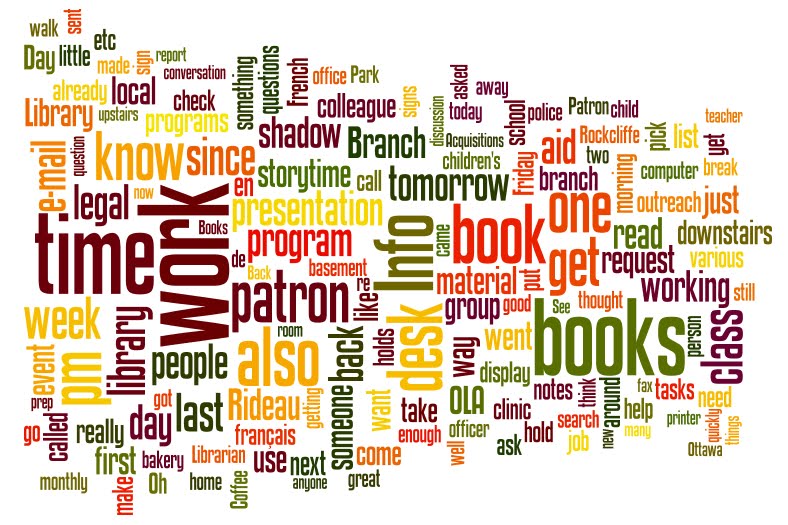 I'm sad that "time" and "work" are so big, but happy that "patron" and "book" are pretty big, too!
Subscribe to:
Posts (Atom)

