Munster branch, Ottawa Public Library, housed in the heritage building of the former St. Stephen's Anglican Church, 1886.
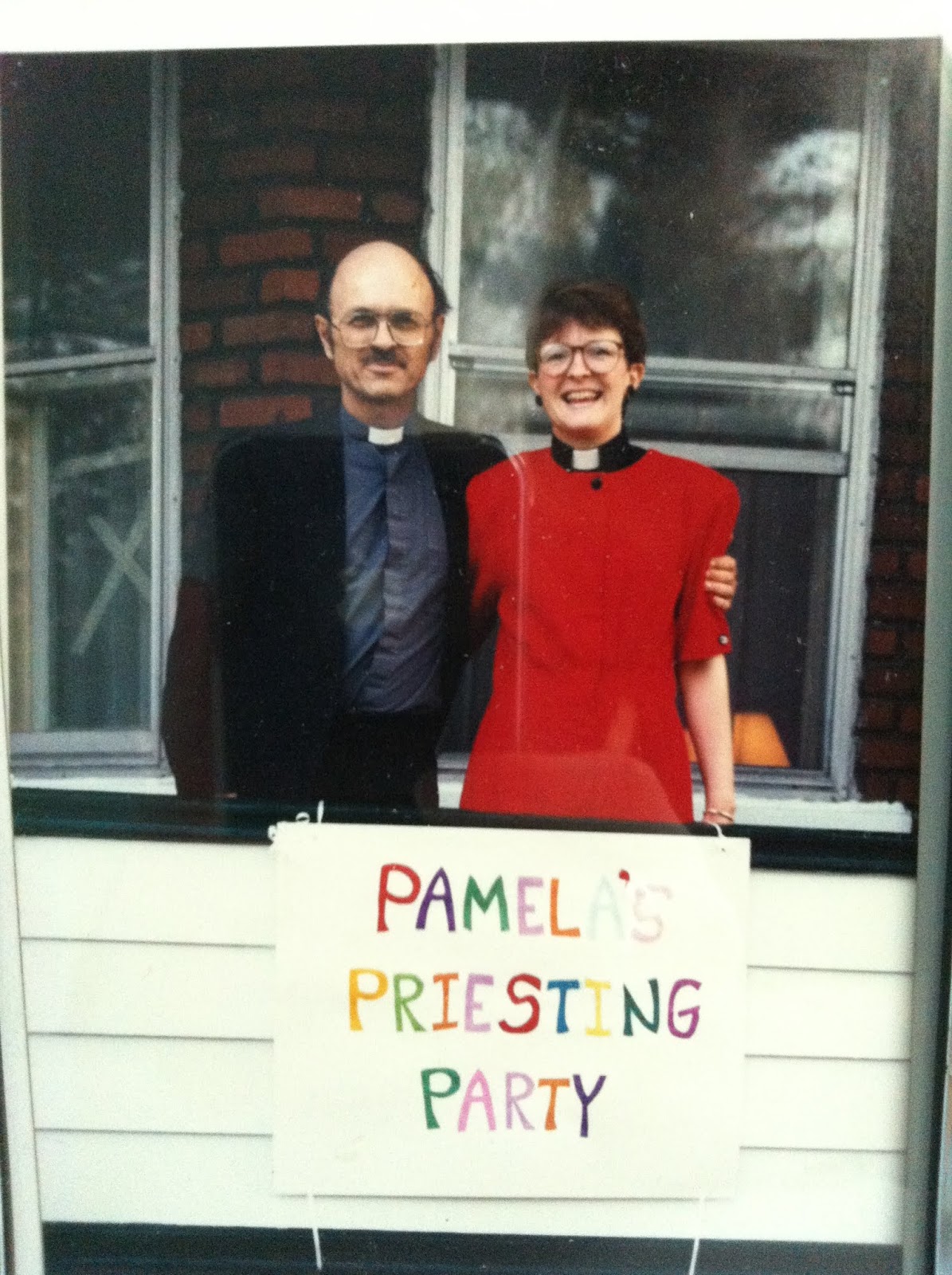
I grew up the daughter of two Anglican priests. For much of my childhood (9 up), I was raised by my mother, who served in parishes suburban and rural. It's only recently that I've gained enough perspective on those times, from a "professional" point of view, to think concretely about how much I learned, and why I work the way I do, based on what I observed during that time in my life.
I'm not going to get into what else I observed, besides work culture and professional attitudes, because, um, that's a whole other story. I will say that I certainly saw the best and the worst of human nature and human behaviour. The rest is for another day, my pretties.
Recently, however, I was thinking about the similarities between the profession my parents chose and the profession I have chosen. My mother organised a Fall Speakers' Series at her parish (scroll down to Wednesday
here) and it reminded me so distinctly of some ideas I have had for Rideau Branch that it sparked a whole train of thought in my head. Sometimes, whether calling on local experts to give public talks on a subject, or unplugging the toilet because no one else is there to do it, I have to blink to remind myself we're not in the same profession.
Granted, some initial observations are obvious. The priesthood, and librarianship, can both be considered to be vocations. Both are "trusted" and - in most cases!- non-partisan voices. Both are service professions that work under a shared set of values and principles, rather than under the banner of commercialism or profit (um, ideally, anyway). Both think the written word is pretty much paramount (click
here for reasons why church is like a book club). Both like rules a lot (you know I'm only half joking!) This has been discussed elsewhere, most notably in
Sacred Stacks (see also the May 2006 issue of
American Libraries).
I was struck, however, by the extent to which, at least if you narrow my field to public librarianship, our organisational structures are often similar, and how our organisations work on a very similar grassroots community level. I think a lot of what I seem to know intuitively about this work comes from observing my mother do similar work during my childhood and youth.
Both the diocese and the library have "central control" units (a diocese, a director, a governing board), with different departments branching out from there. Some of these departments are in individual communities, outposts where things might work a little differently than the norm, or things have worked a certain way for years. These outposts are staffed by people who may rotate (Markham Public is rotating staff on a 3-year basis! Priests are called to different parishes every few years! Compare and contrast that with your library....). Those professionals staffing those departments in individual communities may also serve on central committees, allowing them to socialise and share ideas with colleagues working for the same organisation but separated by sometimes a great geographical distance. This is something I never underestimated, watching my mum traipse in from
Bedford to attend council and Synod. The conversations, and resolutions passed, may be to your liking or not, but the benefits (sharing with colleagues, lunching with friends, trading ideas and supporting each other) outweigh the drawbacks (the cost, the commute, dealing with the difficult people). I'm so glad I learned that, and the lesson has served me well when working in smaller libraries, or in new communities, when you need that professional connection as a touchstone to ward off becoming stale, and desperate.
Back in the outposts, within individual communities, is where the real work gets done, of course, by the community librarian and the parish priest. The organisation often survives on "word of mouth" recommendations in the commmunity (I have seen people leave a parish or a library branch when a new priest or librarian comes along!). The day-to-day small battles, on the ground, in the community, help win the war and foster a positive impression of the profession as a whole.
Each community has its own subset of values, and may feel differently about aspects of the service that "make or break" an individual's experience in the environment. This can be crucial: professionals might not last too long in an environment that isn't a good fit for them. In churches, some of these values might include strong opinions about architectural space ("I can't worship in that modern monstrosity!" or "Ugh, that old Gothic building is cold!"), types of music, appropriate places for children, volunteer spirit and involvement, use of formal or informal language; in libraries, some of the same stand: people are certainly drawn to a certain library because of architecture, some even going out of their way to keep the same home branch after their -actual- home has moved. What is the appropriate place for children? How much do you rely on your staff and incorporate volunteers? Music may not be a factor in libraries, but noise and how you deal with it certainly is!
There is also a significant importance placed on involvement in community life and development of partnerships in both organisations. I grew up accompanying my mother on various "outreach" visits: to homes, seniors' residences, community groups, picnics, schools and so on. I certainly don't do home visits, but I did spend a summer responsible for shut-in service, which is comparable. Outreach (
however you interpret it) is key in both professions: it shows respect for and willingness to value input from marginalised populations and groups, spreads the word about services, and, as an added bonus, it raises your street cred (see? Now, you must admit, neither librarians or priests are known for that, usually!)
Some of the more problematic characteristics that both professions share include a certain sense of comfort dealing with the under 6s and the over 50s. The flip side of this, of course, is that neither of us have done a very good job of relating to, or being relevant to, youth, young professionals and families, and those in their 40s. Yes, yes, you could argue for the evangelicals, or for the libraries that seem to espouse that evangelical zeal (I am not naming names. I'm not here to criticise what might be over-the-top, selling-your-soul-to-Satan, marketing). Overall, though, both groups are, frankly, somewhat wary of these populations and have a tough time meeting their needs under the confines of what they consider service to the community.
Maybe what we consider service has to change a little bit, or, at the very least, we need to start hiring people who actually care about the needs of these groups. Our own professional demographics could also stand to be tipped in the same direction (what's that # again? 50% of librarians are over 50? Seen many younger priests around in positions of authority, either? Didn't think so).
While we're on the topic of hiring for our community's needs, let's talk public speaking. Neither librarians or priests went into the profession thinking, great, this is really a place for me, since I love giving speeches on a weekly basis! Yet we find ourselves giving elevator speeches to community organisations we want to partner with, or meeting with groups as diverse as city councillors and teen mums, talking about library programs and services, or giving booktalks and leading book clubs, and it's not that different from a parish priest going to a local school or giving a weekly sermon, and we catch ourselves thinking, how did we get into this, again? Both fields need to attract, encourage, and actively recruit great speakers, strong voices, passionate defenders. And, if you're working in a parish or leading storytime, a good singing voice or some skills on the guitar wouldn't hurt, either.
All joking aside, there are some real connections between these two fields, and a lot we can probably learn from each other in (equally) troubling times for our professions. On a more personal level, my mum certainly modeled good professional behaviour in any situation, and committment to a vocation, and that has influenced me a lot and probably made me the librarian I am today.