Showing posts with label anglicans. Show all posts

Sunday, August 5, 2018

New beginnings

Today is the end of an era, as the Venerable takes her last service as an incumbent. Fittingly, the lessons were about violence against women (Bathsheba) and the ministry of making more with less. In their quietly supportive and thoughtful way, the parish called her up during the postlude for a laying on of hands.


I estimated this week that I have probably attended 1964(ish) church services in my (relatively short!) life. I think it's safe to say that almost everyone underestimates the fact that the parish priest is one of the roles most in the public eye in a community.


Over the years, I have listened to some of the best music ever, seen some of the worst liturgical dancing, skipped the lessons to grab a coffee at McDonald's across from the cathedral with my friend Marianne (the verger came outside to let us know when to get back in time for communion), seen a mentally ill individual do the Nazi salute in front of the cross, had the privilege to sing morning prayer (BCP) accompanied by a barrel organ in my heart's own country church in Rougemont, been pumped for info about my young single mother, witnessed fainting, heart attacks, and broken hips, heard hate speech and seen unspeakable petty cruelty, felt the boundless, deep love of those who tended the flame of my father's memory, made friends with a poet in a graveyard, learned about what happens with absolute power, watched true love blossom among two 80-somethings, observed the capacity for generosity take root in unexpected hearts, taught Sunday school in an attic, been a server, read lessons, avoided the altar guild at all costs, seen someone hide a teen pregnancy, burned myself on innumerable candles, crushed the patriarchy (but only a little bit), found peace, lost my patience, opened my own heart, and - above all else - protected those I love from the politics of it all, and learned from the grace of this woman.


P.S. I realised I am posting a few things on places like Facebook that I don't want to consign to the Zuckerberg dustbin, so I am re-posting (sorry to those who receive this twice!)

Saturday, June 18, 2011

Women priests

"How good does a female athlete have to be before we just call her an athlete?"

I've written here before about the tremendous influence my mother has had on me, specifically professionally. Taking a step back, here are the women who, in many ways, also helped me become who I am.

Photo credits here and below go to Rene Sanchez.

You are looking at a photo of women clergy, assembled last weekend to celebrate the 35th anniversary of the ordination of women to the Priesthood in the Diocese of Montreal.

None of these women have walked an easy path; their strength and professionalism are incredibly inspiring to me. I am proud to be the daughter of the eighth woman priest ordained in the Anglican Diocese of Montreal; I am proud to know some of the women priests who came before and after her.

I do not talk about what my parents do/did for a living very often. As a child and young adult, I rarely mentioned it, afraid I would be judged to be an evangelical nitwit. In my old age (ha), I now sometimes throw it out there, to see what reaction I will get. The best reaction I have ever had was that of a very intelligent and sensitive colleague of mine recently. She thoughtfully and delicately inquired next whether I still attended church, before continuing the conversation. In my heart, I thought, damn right, that's the question I've been waiting to be asked! The answer is, not really.

When pressed, I usually say that I have seen the best and the worst in people through my time in the Church. My experiences have been varied, and very valuable: I come from a small family, and in times of great crisis (my father's death), I have felt supported. Years later, Anglicans still go out of their way to share lovely memories of him with me. For an only child, those experiences were priceless. I have also learned about management, leadership, community, compassion, humanism, power struggles, pettiness, harassment, discrimination, human rights (see also -- violations of), scholarship, philosophy, intellectual rigour, volunteer management, building maintenance, fundraising, archives, choral singing, public speaking, and professional development (oh, don't worry, I'm sure I forgot about a dozen other things in there).

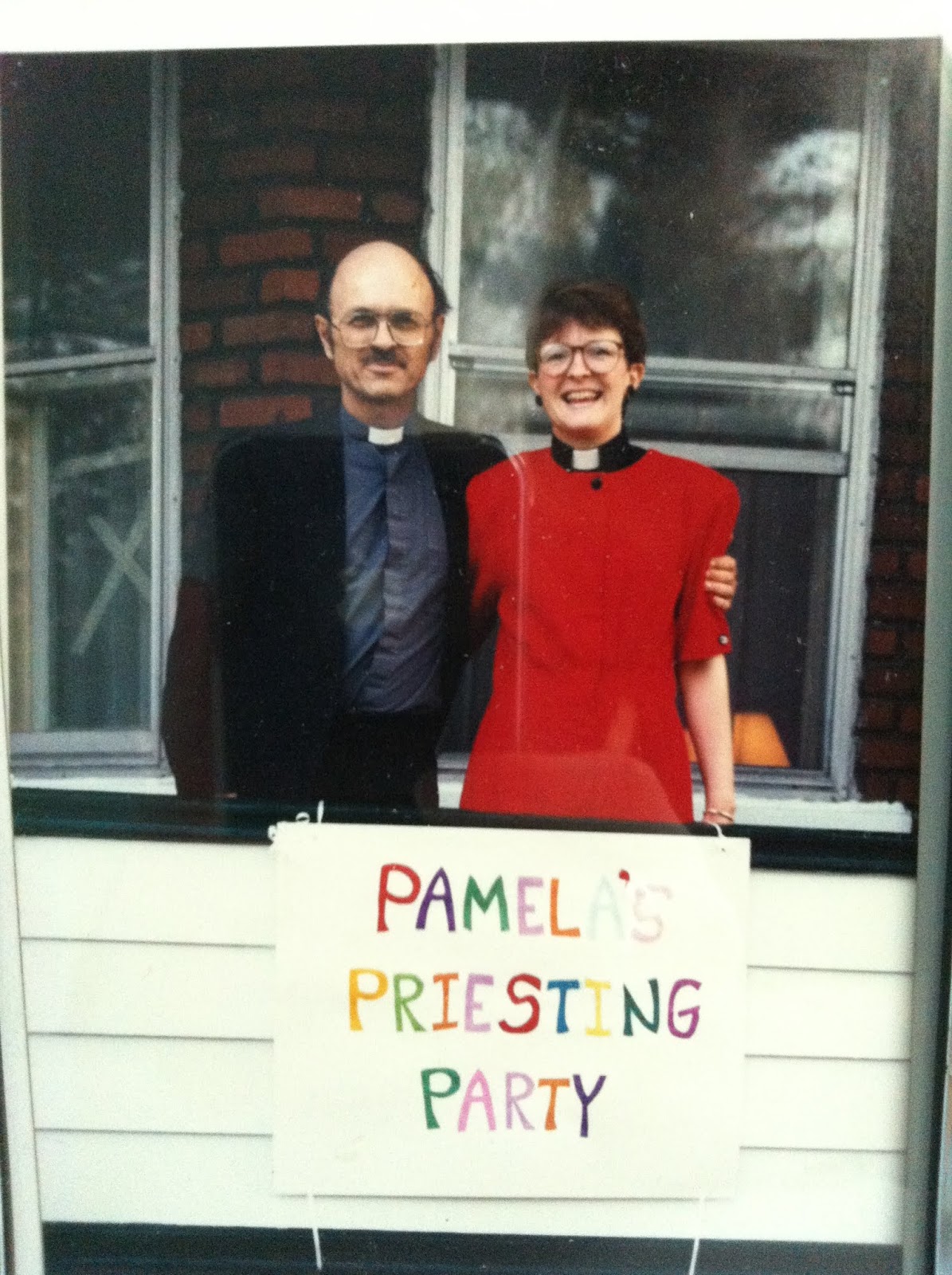
Here's your history minute: The Rev. Canon James (at left, in pale pink) was the 12th woman to become a priest in the Anglican Church of Canada, and the first in the Diocese of Montreal, when she was ordained in 1978 (at that time, "in her early 50s and already the holder of two doctorates," observed a recent article in the Montreal Anglican, in the kind of throw-away reference in these stories that just blows my mind). Others followed in 1980, 1982, and 1985, and then the fifth to be ordained was the amazing Dr. Patricia Kirkpatrick (at far left, in black). In May of 1989, my mother (at left, in blue) was ordained with her friend and colleague, Aloha Smith; both were remarkable also in that they were the wives of Anglican priests already in the Diocese.

My mother was the first woman priest in every parish in which she served.

I have known women who served in parishes where congregants would not take communion from them (every week, for years). I have known women who were verbally and physically harassed, and have either spoken out about it, or not, and who have either been believed and supported, or not. I have known women whose parishioners - or fellow clergy - made snide remarks about their hair, their earrings, their fondness for the colour purple, their loud voices, their heavy foot, their children/spouse or lack of children/spouse, or their age (to name but a few things!) I have also known parishioners and fellow clergy who have gone out of their way to include women priests, working alongside them, quietly or loudly confirming their right to be where they are. I have known women who, through all this, blazed a trail of faith, equality, compassion and dignity that is simply exemplary for the Church, and for the human race.

Their remarkable stories are the ones that librarians and archivists should be collecting, and honouring, through oral history projects, archival fonds, and private collections. I was thrilled to hear that a small archival display was put together for last week's event, featuring photographs, gifts, communion sets, and other information donated by the women and available through the Diocesan archives (at right).

To paraphrase one of the women themselves, whatever I say here, it could not possibly be enough.

Of course, I can't close this post without some book tie-ins (see - you thought I was totally off-topic today, didn't you? Have faith, readers!)
  • The theological writings of Elaine Pagels or Rosemary Radford Ruether
  • Bread not Stone by E. Schussler Fiorenza
  • Readings in Her Story, edited by B. J. MacHaffie
  • Feminist theology with a Canadian accent (no, I did not make that title up!)
And, for a lighter touch:
  • Julia Spencer-Fleming's mysteries about a woman Episcopal priest in the U.S.
  • Beneath the Cassock by Joy Carroll—the British priest on whom The Vicar of Dibley was based

Monday, November 30, 2009

Communities

Munster branch, Ottawa Public Library, housed in the heritage building of the former St. Stephen's Anglican Church, 1886.

In the beginning, was the word....

I grew up the daughter of two Anglican priests. For much of my childhood (9 up), I was raised by my mother, who served in parishes suburban and rural. It's only recently that I've gained enough perspective on those times, from a "professional" point of view, to think concretely about how much I learned, and why I work the way I do, based on what I observed during that time in my life.

I'm not going to get into what else I observed, besides work culture and professional attitudes, because, um, that's a whole other story. I will say that I certainly saw the best and the worst of human nature and human behaviour. The rest is for another day, my pretties.

Recently, however, I was thinking about the similarities between the profession my parents chose and the profession I have chosen. My mother organised a Fall Speakers' Series at her parish (scroll down to Wednesday here) and it reminded me so distinctly of some ideas I have had for Rideau Branch that it sparked a whole train of thought in my head. Sometimes, whether calling on local experts to give public talks on a subject, or unplugging the toilet because no one else is there to do it, I have to blink to remind myself we're not in the same profession.

Granted, some initial observations are obvious. The priesthood, and librarianship, can both be considered to be vocations. Both are "trusted" and - in most cases!- non-partisan voices. Both are service professions that work under a shared set of values and principles, rather than under the banner of commercialism or profit (um, ideally, anyway). Both think the written word is pretty much paramount (click here for reasons why church is like a book club). Both like rules a lot (you know I'm only half joking!) This has been discussed elsewhere, most notably in Sacred Stacks (see also the May 2006 issue of American Libraries).

I was struck, however, by the extent to which, at least if you narrow my field to public librarianship, our organisational structures are often similar, and how our organisations work on a very similar grassroots community level. I think a lot of what I seem to know intuitively about this work comes from observing my mother do similar work during my childhood and youth.

Both the diocese and the library have "central control" units (a diocese, a director, a governing board), with different departments branching out from there. Some of these departments are in individual communities, outposts where things might work a little differently than the norm, or things have worked a certain way for years. These outposts are staffed by people who may rotate (Markham Public is rotating staff on a 3-year basis! Priests are called to different parishes every few years! Compare and contrast that with your library....). Those professionals staffing those departments in individual communities may also serve on central committees, allowing them to socialise and share ideas with colleagues working for the same organisation but separated by sometimes a great geographical distance. This is something I never underestimated, watching my mum traipse in from Bedford to attend council and Synod. The conversations, and resolutions passed, may be to your liking or not, but the benefits (sharing with colleagues, lunching with friends, trading ideas and supporting each other) outweigh the drawbacks (the cost, the commute, dealing with the difficult people). I'm so glad I learned that, and the lesson has served me well when working in smaller libraries, or in new communities, when you need that professional connection as a touchstone to ward off becoming stale, and desperate.

Back in the outposts, within individual communities, is where the real work gets done, of course, by the community librarian and the parish priest. The organisation often survives on "word of mouth" recommendations in the commmunity (I have seen people leave a parish or a library branch when a new priest or librarian comes along!). The day-to-day small battles, on the ground, in the community, help win the war and foster a positive impression of the profession as a whole.

Each community has its own subset of values, and may feel differently about aspects of the service that "make or break" an individual's experience in the environment. This can be crucial: professionals might not last too long in an environment that isn't a good fit for them. In churches, some of these values might include strong opinions about architectural space ("I can't worship in that modern monstrosity!" or "Ugh, that old Gothic building is cold!"), types of music, appropriate places for children, volunteer spirit and involvement, use of formal or informal language; in libraries, some of the same stand: people are certainly drawn to a certain library because of architecture, some even going out of their way to keep the same home branch after their -actual- home has moved. What is the appropriate place for children? How much do you rely on your staff and incorporate volunteers? Music may not be a factor in libraries, but noise and how you deal with it certainly is!

There is also a significant importance placed on involvement in community life and development of partnerships in both organisations. I grew up accompanying my mother on various "outreach" visits: to homes, seniors' residences, community groups, picnics, schools and so on. I certainly don't do home visits, but I did spend a summer responsible for shut-in service, which is comparable. Outreach (however you interpret it) is key in both professions: it shows respect for and willingness to value input from marginalised populations and groups, spreads the word about services, and, as an added bonus, it raises your street cred (see? Now, you must admit, neither librarians or priests are known for that, usually!)

Some of the more problematic characteristics that both professions share include a certain sense of comfort dealing with the under 6s and the over 50s. The flip side of this, of course, is that neither of us have done a very good job of relating to, or being relevant to, youth, young professionals and families, and those in their 40s. Yes, yes, you could argue for the evangelicals, or for the libraries that seem to espouse that evangelical zeal (I am not naming names. I'm not here to criticise what might be over-the-top, selling-your-soul-to-Satan, marketing). Overall, though, both groups are, frankly, somewhat wary of these populations and have a tough time meeting their needs under the confines of what they consider service to the community.

Maybe what we consider service has to change a little bit, or, at the very least, we need to start hiring people who actually care about the needs of these groups. Our own professional demographics could also stand to be tipped in the same direction (what's that # again? 50% of librarians are over 50? Seen many younger priests around in positions of authority, either? Didn't think so).

While we're on the topic of hiring for our community's needs, let's talk public speaking. Neither librarians or priests went into the profession thinking, great, this is really a place for me, since I love giving speeches on a weekly basis! Yet we find ourselves giving elevator speeches to community organisations we want to partner with, or meeting with groups as diverse as city councillors and teen mums, talking about library programs and services, or giving booktalks and leading book clubs, and it's not that different from a parish priest going to a local school or giving a weekly sermon, and we catch ourselves thinking, how did we get into this, again? Both fields need to attract, encourage, and actively recruit great speakers, strong voices, passionate defenders. And, if you're working in a parish or leading storytime, a good singing voice or some skills on the guitar wouldn't hurt, either.

All joking aside, there are some real connections between these two fields, and a lot we can probably learn from each other in (equally) troubling times for our professions. On a more personal level, my mum certainly modeled good professional behaviour in any situation, and committment to a vocation, and that has influenced me a lot and probably made me the librarian I am today.

Monday, November 9, 2009

The wall came down

"And I wake up and I ask myself what state I'm in,
And I say well I'm lucky, 'cause I am like East Berlin.
I had this wall, and what I knew of the free world
Was that I could see their fireworks,
And I could hear their radio.
And I thought that if we met, I would only start confessing,
And they'd know that I was scared,
They'd would know that I was guessing.
But the wall came down, and there they stood before me,
With their stumbling and their mumbling,
And their calling out just like me..."
- Dar Williams, "What do you hear in these sounds?"

Twenty years ago today, the Berlin Wall came down. Well, to be entirely accurate, the gates were opened and people were allowed to travel between East Berlin and Berlin without ID checks. The wall woodpeckers, chipping away at the Wall itself (or, as we all memorably saw on TV, smashing it with sledgehammers) came later.


On the same day, something of less global significance happened halfway around the world: my father died.

It takes every bit of courage I have to keep writing past that last sentence. I don't like to talk about this except with one or two people, and I have come to realise recently, more than ever, that my habit of "pushing things down" is not an entirely healthy one. Coupled with a significant anniversary (twenty years is, frankly, almost unfathomable), I decided that it was time to talk, if only to my (limited, let me tell you) subscribers. I feel an almost crushing need to share some stories on this anniversary, to mark the passage of time in a meaningful way.

I find myself mentioning my father more now, in passing, briefly, alluding to his jokes with my students at Algonquin ("What's the difference between a dissertation and a thesis?" "Well, one is in fulfillment of requirements to become a Phony Doctor.") I talk about his love of the theatre (his own phony doctorate was in English Lit, and his dissertation focused on the stage history of Romeo and Juliet - since I am spending waaaay too much time these days on Amicus, I would refer you to Amicus #s 85462, 6756158, and 10132599). I've explained to dozens of people how momentous my upcoming trip to England is, being the first time I have travelled there since the early 90s, and the first time I am spending with my father's family as a whole since the mid 80s.

Sometimes this is easy for me, and comes naturally, and sometimes it shatters me just to get a trivial memory out of my mouth. I know it's what I need to do, though; the more time passes, the more I realise that this is how someone lives on: in sharing those stories, those memories, with others. It's the best way to keep him alive for me, for my family and friends, for my students and work colleagues, none of whom he ever met.

I've recently understood how much of an introvert I am, and that there is nothing wrong with how I handled my father's death (although it's not a good way to, say, live a whole life). The tragedy made me withdrawn: for years, I didn't talk to anyone about him: I remember my mother bringing home those kids' books about grief (if I could recommend one that didn't exist at the time, it would be Michael Rosen's Sad Book, which made me weep openly at work a few years ago), trying to start the conversation, but to no avail. I remember my mum's friend and colleague Ros trying, in her kindness, to break the shell, and how I was so utterly mortified at her attempts. I felt like I didn't have the language to talk about it. I didn't miss a day of school, and carried my grief (selfishly) close to my heart.

It was only in high school that I made my first true best friend, someone I am privileged to still share a very wonderful friendship with. I felt comfortable talking to her, and so she was the first to hear how deeply I was still grieving. She and I observed the anniversaries of my father's death, and his birthday, by doing something together, whether it was as small as sharing a box of Smarties (my father had an outrageous sweet tooth). It was what I needed, and I am forever in her debt for creating the kind of relationship where, for whatever reason, I felt like I could talk.

I am indebted in many ways, also, to the Anglican community of Montreal. Lacking a larger extended family, I was able to see in them a collective memory bank. Many went out of their way over the years to tell me a story about my father, or simply to say they remembered him. Every time I see Ros (which, granted, is not that often) she tells me my father would have been proud of me. My mother is now serving as interim priest in the parish my father served in during the late 70s and early 80s. A woman came up to her recently, saying she had such fond memories of my father: she recalled how he welcomed her as a child, made her feel important, made her believe she could do and be anything. She told my mother that this acceptance and encouragement made her believe in herself, and years later, she remembered his compassion and generosity. I have had my issues with this community, over the years, but I have nothing but admiration for the ways in which they can rally around people in a time of need, and, in my case, for years afterward.

I am amazed at the sheer weight of grief: it is still there, every day, every week. There is hardly a week that goes by that I don't miss my father. Years ago, when downsizing, we gave away a number of his old books. Some ended up on the booksale truck at Westmount Library, when I was working circ. I was OK with the books going, but it was hard to be the person actually tallying up the sale. It was only when a father and daughter came in and bought a few that I thought, let it go. I still snipped out the edges of the endpapers, where my father had inscribed his name and the year he obtained the books, and spontaneously pocketed them. Two of these endpaper triangles are still in one of my suit jacket pockets, and when I reach in, I am comforted.

I am a librarian because my parents read to me, and I saw them reading, voraciously as a child. I am a librarian also because my mother took me to Westmount and Atwater Libraries, as well as to the Birks Reading Room and the Diocesan College Library at McGill (I was heartbroken to see Dio. sold last year). I am a librarian because my great-aunt bought me virtually every Nancy Drew book, from the original hardcovers to the Case Files. I am also a librarian because I saw ignorance and intolerance around me in my college and university years (anti-gay sentiment in church youth groups, religious hatred and incomprehension of my Muslim boyfriend at the time around 9/11) and I truly believe that education and literacy are the keys to stamping out intolerance in the world. But sometimes I think I really became a librarian when books, specifically those books, my father's books, became sacred to me. They were a link we could share beyond other, more permanent, boundaries.

So, in the spirit of those high school Smarties, I urge you to do something for me, today, to maintain that link. Big or small, it doesn't matter. Here are some ideas:
  • Sing or play the piano.
  • Eat some After Eights. My father convinced me to leave them for Santa because they were "his favourite."
  • Read some Shakespeare.
  • Tell a lame joke (my mother would likely recommend the one about the two skunks, In and Out. It involves a long, "Who's on first?"-style monologue, but here's the abbreviated version: In and Out got lost in the woods, and Out finally found In. When asked how he found his brother, Out says, "In stinked").
  • Smoke a pipe.
  • Write a funny limerick.
  • Use the phrase "back to you with knobs on!"
  • Play the "Frank's Trucking" game: yes, this needs explanation. You know, reverse the first letters or syllables of a phrase: go to the ost poffice to pick up your package, park in the larking pot, etc. Now figure out why Frank's Trucking is the classic example....
  • Move to a new country.
  • Change your life.
  • Change your student's lives.
  • Show compassion.
  • Be a leader who can be relied upon to support others and inspire them to greatness.
At the time of his death, my father was chaplain at the Royal Victoria Hospital and editor of the Montreal Churchman (now the Montreal Anglican, for, um, obvious reasons...). The last editorial he wrote was entitled "Too Many Armadillos." A poem about the compassionate, suffering Jesus seen in the Gospels, it talks about a Jesus who "sighs / and weeps / and rages. He is sometimes at a loss for words." My father writes,

They break his body
but not his spirit.
And I can identify with that.
I can accept a Saviour who has suffered,
and let go of pride, prestige, and self;
Never one who is invulnerable;
Never one who covers up the cracks, denies the earthquakes;
Never one who pretends to know it all.

People, priests and prelates alike
Do themselves no service when they act like the armadillo.
Who can relate to the armadillo
when there's hailstones and coals of fire falling about our ears?
Give me the Man of Sorrows;
the Jesus who said he felt forsaken!
Give me the Christ who was misunderstood.
His power, as stubborn Saul found out,
is "made perfect in weakness."
Not in covering it up,
Nor in pretending it doesn't exist.


Something I suspect I am often guilty of, in my personal life and perhaps even in my professional life. I hope I can do better. I tend to be very much of a "stiff upper lip" kind of person, which I think I thought was "admirable" until recently, when I realised that it can have some pretty awful side-effects for a person's development and self-awareness. I am trying to be more open, and this is my first genuine effort, here, kids. I think it's important to share this, both for myself, so that I can begin to be less of an armadillo, and for others, so that anyone stumbling on this post in their own grief might be comforted.

Now go out there and eat some chocolate.