Saturday, November 26, 2011

RA in a Day 2011: Luncheon speaker, Charlotte Gray

I was the convenor of this session, and Charlotte’s “handler,” so I have to confess I didn’t get many notes down! But here are some observations:
  • I had never heard Charlotte speak before, and I was kind of thrilled to discover that she has a very sharp sense of humour.... Speaking about Dawson City in the 1890s, Charlotte deadpanned: “150, 000 people and 3 public toilets: that's what history smells like." She also protested my introduction of her was fulsome....Bah!
  • Charlotte spoke about her most recent book, Gold Diggers: Striking It Rich in the Klondike. Gold Diggers follows the stories of six historical figures who arrive in Dawson City, Yukon during the gold rush. Charlotte sketched several of the characters in her novel for us, including Father Judge, a Jesuit priest, Belinda Mulrooney, who became the richest business woman in town by opening a hotel in nearby Grand Forks, and Flora Shaw, colonial editor and correspondent for the London Times, who crossed the White Pass trail in 1898 and wrote about it; Sam Steele, the head of the RCMP’s Yukon detachment.
  • Charlotte spoke about the fine line writers walk when writing historical non-fiction: as she described it, "I do not invent, I imagine."
  • She explained that the dialogue in her books is what people really said, taken from their diaries and letters.
  • She gave us some great snapshots into her research processes, sitting at LAC reading Flora Shaw’s letters, or consulting the Sam Steele collection at the University of Alberta.
  • Charlotte also gave us an idea of why she began writing historical non-fiction: when she arrived in Canada from England, she expected it to be very similar to Britain, and found that it wasn’t. She described what she called an uniquely Canadian character: an endless landscape, the idea of "the North."

Friday, November 25, 2011

Seen reading on OC Transpo

In line

Ambition is not a dirty word, and neither is change

One of the most comforting things about NELI was being around other people who are driven to make a difference in the library world(s). I honestly had a moment: wait, you mean these people are like me? There's nothing wrong with me?

In other circles, this is called enthusiasm. In still other circles, it is called ambition. In many of these circles, these are derogatory terms.

Ambitious people seem to thrive on change. I've been thinking a lot recently about my past, and about how the library world is at a bit of a turning point that perhaps my whole life has helped prepare me for. My next (home) move will be my 12th; my next professional move will be the 13th different job title I have had in libraries, since starting as a library assistant in the Marianopolis College Library in 1998 (and I'm not even counting working at Vanier during Rideau's renovations, or temporarily supervising Rockcliffe Park, but I did count Westmount 3x, since I had about five different job titles there - whatevs. Read more here).

I kind of hated moving houses so much: making friends and losing friends was difficult for me. I was painfully shy for a long time, until my early teens (ya. I know. Libraries totally never attract shy people. Don't get me started on how this kills us....). At that point, having spent several awkward years alone at (different) church coffee hours, waiting for my mum's parishoners to be done with her so we could go home, I saw years of more of the same stretching ahead of me, and decided that the only way to make this all less awkward was for me to change. I began initiating converstions, learning about the parishoners, asking after their children; in many ways, although it isn't a time I look back on exclusively fondly, it made me a better person: more thoughtful, more compassionate, and more independent.

I talked about these skills at NELI, crediting my mother as a role model, which she certainly continues to be. I entered the library profession as a young adult familiar with organisational change, comfortable coming into a new situation and evaluating the dynamics. I also saw my career as a vocation, something I felt I was doing because I believed that education and lifelong learning were vital to our modern world. I quickly had my heart broken, having to leave the library at which I had made my home (the longest I had been in a community, in any capacity, my entire life). This ended up being the best decision I ever made. It taught me that sometimes the best decisions are the hardest ones, and the most unlikely; it also taught me that sometimes you might be ready to change, but you need a kick in the pants.

I arrived in Ottawa wanting to stand out. Because my talented mother was treated like crap by the church. Because I felt I had a lot to offer, and I was sick of having my heart broken. Because I am by nature someone who gives everything to a project or a person she believes in. Because, because, because.

And now that I am perhaps entering the mid-career phase, I am attending this slew of retirement parties, and we're all dancing along the cliff edge of baby boomers leaving the workforce. The world is opening up, career-wise, and it's both a fascinating and a truly dynamic time to be in libraries.

I'm also feeling the backlash against that. Many of us are scared, facing the first changes in staffing or organisational structure they have ever faced. I understand that. Many are saying, "gone are the days when someone worked for one institution for 40 years," and I'm thinking, when were those days? My parents never did that (but then, my situation is a bit, ahem, weird, right?) I've lived through a lot of change - and hated it at the time - but I've come through the other side more or less intact.

And now, as they say, I have a taste for it: in my own career, I have been so lucky to work with great people, and I have also sought out opportunities for diverse projects and new challenges. You only get one life: you might as well not get bored. I inherited a strong work ethic, and I am proud of my parents for instilling that in me. I have a fierce passion to make public libraries the most amazing places that they are capable of being, and I am proud of myself for that. I will go anywhere where I can do that (I almost wrote, "preach that gospel" - see? Can't shake your roots). I also have come to believe in myself, and each new change has shown me how much more I have to develop, and how much more I can grow.

It's not so bad over on the other side of change. You grow a lot. Life is rich.

Wednesday, November 23, 2011

Bookmobile news round-up


Prey on the weak much? "Library board mulls cutting jobs, literacy program in budget crunch," via the Globe and Mail
"A clear majority [of the Library board] have no interest in a reduction of hours, something Chief Librarian Jane Pyper suggested as a means of lopping 4.3 per cent off the agency’s budget, the remaining amount it must lose to meet Mayor Rob Ford’s demand of a 10 per cent cut. The board had already consented to a 5.7 per cent cut by eliminating 100 jobs and introducing new technology. But Ms. Pyper gently reminded the board that if it doesn’t squeeze 4.3 per cent in hour reductions, it will likely have to consider dropping adult literacy, bookmobile and student homework programs."

"Wielklem voor bibliobus in Maurik", via YouTube (and via Dr. Mary Cavanagh!)
There is less and less money for libraries. Many municipalities have cut back. Neighbors is the first municipality that decides to not have money to spend on a library. Children today are therefore the plans into action. They can take a chain of children all about the mobile library to go.

"Rosendale Primary School was announced winner of the SLA Library Design Award for 2011, " seen via Twitter
"Rosendale Primary School's Library Bus is ‘visionary’. Not in the sense of a library in a bus, as that is certainly not unique. But the concept of a school community volunteering together to design and build a new school library in a bus… this is truly visionary. Rosendale Primary School has 700 pupils housed in a cramped Victorian building. They needed a library, but there was neither the money nor space to build one. Instead, parent Kate Gorely had the idea of converting a London bus into a fit-for-purpose library. At a cost of slightly over £5,000 a group of 50 volunteers achieved just that in only nine months."

"Boonslick Regional Library gets some new wheels," by Megan Tilk, Boonville Daily News
"Recently, the library purchased a 2006 ELF Farber Ford E450. With an original cost of $182,500, the library's purchase cost came in at a lot less. previously used and kept in storage for two years, the library was able to purchase the new set of wheels for just $62,999 [....] The best part of the new van is that it comes with a kneel-down feature. It has the ability to raise and lower depending on the curb height so that way people can access the vehicle without steps. It also has better lighting, computer access and an exterior canopy."

"An Airstream Ingeniously Repurposed into a Library," via Poetic Home
"A vintage 1959 Airstream was converted into a traveling bookstore gallery no less, complete with exhibits of independent magazines, artist publications, and more literary goodness."

When he was homeless, "Mendonça took refuge in reading.He says he faced discrimination at the Mário de Andrade Municipal Library.“When I would approach a table with a book in my hand, people would get up and leave,” he says.Mendonça was also unable to borrow books because he didn’thave a permanent address.In 2002, he got off the streets, but he never forgot the people he met there.Through his NGO, he’s helped the homeless people return to their hometowns, get jobs at hostels and enroll in vocational courses.With his Bicicloteca, Mendonça provides the homeless with access to books without any bureaucracy and in an environment where they feel comfortable."

Friday, November 18, 2011

Seen reading on OC Transpo: Bonus two-week edition!

Me, on the #95
  • Persuader by Lee Child
  • Ameliorer sa memoire pour les nuls
  • Vernissage magazine
  • A Storm of Swords (A Song of Ice and Fire, Book 3) by George R. R. Martin
  • Vanish In Plain Sight by Marta Perry
  • The End of the European Era: 1890 to the Present by Felix Gilbert and David Clay
  • something by Clive Cussler
  • Sovereign by C. J. Sansom
  • Me: The Antagonist by Lynn Coady, Better Living Through Plastic Explosives by Zsuzsi Gartner, Wildcat Run by Sonya Spreen Bates, and Justine McKeen, Queen of Green by Sigmund Brouwer (Justine was kind of adorable - great for middle grades...)
  • The Husband: An Imperfect Offering by James Orbinski

Tuesday, November 15, 2011

Oh, my pretties! I miss you!

I'm so sorry it's been all automated posts without real thought or insight.

I'm feeling devoid of any more thoughts or insights these days! I'm enjoying my term with OPL's Diversity and Accessibility Services (since March), but my manager and I were both saying today how we feel that it's been about a week since March. The time is flying by this year at work: I pointed out that we've done a lot of great things, but I think we are both going home at night exhausted (I know I am: it's all I can do to say hi to The Husband, eat, rouse myself briefly for Two Broke Girls, make a salad for lunch the next day, and then fall asleep somewhere between 9-11 pm).

Today, a training session I was scheduled to attend was cancelled, which bought me a morning "free," so I got a few things done, but it's like feeding a cranky elephant one peanut - it's just not going to cut it. I woke up at 5 am today, worried about several different things.... Most of which, of course, I have little control over. Bah. Overthinking things. Too emotionally invested in things. Pick the crappy explanation you prefer.

Some days, it's just a fish-eat-fish world....

(That's the Fish Hall in McGill's Engineering Building, btw)

I do have some (read: more than one!) fun projects up my sleeve (shhhh my pretties..... Soon!), so that's good. In the next little while, I'm going to nominate people for awards, give out cards, clap when a dangerous area of our offices gets re-paved, oversee two VIP ride-alongs on Bookmobile, and go on two outreach trips (bringing three new-ish employees for professional development)... all while attending at least two more retirement parties (this year has been WHACK for that stuff) and at least three OPL Christmas parties.

Also, in the "not-really-important" category, you know what I love? (Chocolate-glazed doughnuts? Members of my team stretching themselves to learn new things? Cracking the spine of a new novel? Finishing a 3-month long project? Sitting in the front row of a ballet? Holding hands with the husband? Lunch with a friend? 3-day weekends? Kat Dennings? Malbec? Montreal and London?) No, no.... My office at Main Library. Basement and all, it's growing on me, but I think that's J. Alfred Prufrock's influence (words to live by, in this case - and the answer is YES!)

Meanwhile, here are some recent 10-second book reviews from since we last spoke:
  • State Of Wonder by Ann Patchett: reading it before Carrie kicks my butt. We have to schedule a mini-book club / debrief in my office when I am done. So far, really enjoying it.
  • The Marriage Plot by Jeffrey Eugenides: If you looked up "Contemporary (ok, 80s) American Novel" in the dictionary, this book should be listed. I definitely liked it; it had AMERICAN REALISM written all over it, but not in a bad way. I felt for Madeleine, especially when Eugenides focused on her reasons for / feelings about staying with a man who evidently has some mental health issues, but other readers might just want to smack her. Bonus points for saying nice things about Quakers (since my uncle was one, that is, in case you are wondering...)
  • Better Living Through Plastic Explosives by Zsuzsi Gartner: A bit too out there for my taste (sorry, I am a total square) but, on an intellectual level, I appreciated it. Whoa, snap, that sounded bad. My Giller prediction to Kris, shouted out across the living room 2 minutes into the broadcast, was "If they want to be really brave and alienate the general reader, they will give it to Zsuzsi. If they want to be sort of brave , they will give it to Esi."
  • The Antagonist by Lynn Coady: Oddly compelling, despite subject matter that isn't usually up my alley.
  • The Night Circus by Erin Morgenstern: Beautiful book; couldn't really care less about the characters.
  • The Tiger's Wife by Tea Obreht: Disturbing, engrossing, weird. In the best possible way.

Must dash. Dizzy with fatigue.

Friday, November 11, 2011

"Give me the time"

Tomb of the Unknown Soldier, Ottawa, 2009

Give me the time to lie and dream,
To lull the hours with reverie
And set my sluggish fancies free
Upon the tide of beauty's stream.

Give me the time to rest my mind
From thoughts of massacre and war,
To think awhile of life, before
The chance is left too far behind.

Give me the time to seek for truth,
Wherever it may be concealed,
And time to savour of its yield
Before I lose the eyes of youth.

Give me the time to fill my heart
With draughts of love and ecstasy,
To pierce the core of life and be
The favoured sculptor of its art.

Give me the time to gain release
From war's insistent ache and stress;
Give me a glimpse of happiness
That I may know the ways of peace.

John Cromer, "Give me the time," Poems of the War Years: An Anthology. London: Macmillan and Co., 1950.


This is my great-grandmother's brother, Lew Jack Melhado. His sister had already left England for Canada, as part of the British Women's Emigration Association, when he joined The Northamptonshire Regiment, 6th Battalion. He died in France, on 1 July 1918, aged 23, at Pozieres, the Somme. Between 21st March to 7th August 1918, when Pozieres was lost and re-taken by the British, 14,669 men died.

Wednesday, November 9, 2011

"A lifetime burning in every moment"


"[....] So here I am, in the middle way, having had twenty years [...]
Trying to use words, and every attempt
Is a wholly new start, and a different kind of failure
Because one has only learnt to get the better of words
For the thing one no longer has to say, or the way in which
One is no longer disposed to say it. And so each venture
Is a new beginning, a raid on the inarticulate
With shabby equipment always deteriorating
In the general mess of imprecision of feeling,
Undisciplined squads of emotion. [....]

Home is where one starts from. As we grow older
The world becomes stranger, the pattern more complicated
Of dead and living. Not the intense moment
Isolated, with no before and after,
But a lifetime burning in every moment."
Eliot, T. S. "Four Quartets." The complete poems and plays. London: Faber, 1969. 182.

Monday, November 7, 2011

RA in a Day 2011: Keynote: "RA as a Transformative Act"

The keynote address at this year's RA in a Day event was given by the amazing Duncan Smith, creator and founder of NoveList. Here are my notes; his presentation is available here.


Duncan opened by reading a quote and asking us where we thought it was from:

"We will help you find the perfect collection of books for reflection resolution or relaxation."

Sounds like it could be from a library? It's actually from the website of an English bibliotherapist. Duncan first heard about her in an article in En Route magazine (“Geek Odysseys - Book Loving in London: Volume 2 Bibliotherapy”). The bibliotherapist profiled, Ella Berthoud, spoke about the importance of novels at life-changing moments, and how the reading of these novels allows us to come back to world refreshed.

Duncan then asked, what is the nature of readers' advisory work? He proposed the following four core ideas:
  1. To help readers understand what they like
  2. To assist readers in finding more of what they like
  3. To deepen readers’ appreciation of their reading
    (Smith told a story about Jane Goodall explaining in an interview how her interest in animals was sparked by reading about Dr. Doolittle and Tarzan. He also mentioned an interview with Mia Bauer, the founder of Crumbs Bake Shop, who spoke of being inspired to open her own business by Edith Wharton's Age of Innocence: “she didn't want to live a life of regret like Wharton’s characters.”)
  4. To support readers in sharing their reading with others (sharing comments via catalogue)
The true product of readers' advisory service is thus not circulation, or the number of interactions we have with the public, or the number of book groups our library hosts, but relationships:
  • between books
  • between readers and books
  • between readers (creating a culture and climate of sharing that deepens understanding)
  • between readers and books and us!
So where are the readers?
One essential thing that Smith identified that we need for effective readers' advisory services is the readers themselves. Those who use the library just for fun are approximately7% of all users, but account for 24% of all visits to the library. What is missing from their profile is interaction with staff. Stats from major Canadian public libraries show that the majority of people who come in to the library are not interacting with staff. Also, stats show increased placement of holds online, which means readers may not visit in person as much anymore. In the US, we see that typically 87% of holds are placed remotely. “People are searching for things they already know about, not coming in to find out more about other things;” they see the library as “a utilitarian service.”

Being connected

This use of the library as a utilitarian service speaks to a lack of connection to the library, and specifically to the skilled staff. Smith pointed out that above and beyond implications for readers’ advisory service, this lack of connection can also affect library funding, because “people who are not connected don't vote for increased funding.” Staff need to focus on not just saying "Sorry, we don't have that," but on starting a conversation with readers. Smith posed the question of how we are behaving in interactions with readers: “are we being reactive, invitational, suggestive, enlightening (teaching how to use Novelist), anticipatory, contributatory, participatory?”

Building relationships

We might think the world is now dominated by technology, but it's actually dominated by relationships and “social capital,” just in different places. Some modern places to build social capital include: in the library catalogue, on the library website, in the blogosphere, on social sites (GoodReads, Facebook, etc). With respect to social websites, Smith encouraged us to engage in outreach to them: ‘places like Good Reads are full of library lovers. We should be connecting with them!”

What is our value? According to Smith, there are three ways readers' advisory experts add value:
  1. Our professional stance: we talk about the promise or potential of books for all readers, not from a personal perspective (eg. “This book is great if you love 18th century mysteries because...” not “I loved this book because....”)
  2. Our focus on the reader
  3. Our “reflective practice:” our use of well-researched and thoughtful criteria to categorise reading (the appeal factors).
The majority of our users are connected “not with your building or your collection, but with you, the staff. And that's why we can't just sit around.”

Friday, November 4, 2011

Bookmobile news round-up

From Jordan to China to Indonesia, to the Boing Airplane Co. in Seattle and a boxcar in Montana- and now with more printables!
  • "Mobile Services, The Seattle Public Library -- The Bookmobile," via HistoryLink.org (editorial comment: Aweseome pictures)
    "On May 4, 1931, Seattle's first bookmobile, with 600 books, hit the road to West Seattle. Each day of the week, the van and its driver and librarian visited different parts of the city, making stops at prearranged locations. The last stop on Mondays was the Boeing Airplane Co. The bookmobile, designed by Arthur D. Jones of Seattle, featured four innovative bookshelves -- two on each side -- that rotated inside or outside. On nice days, borrowers browsed books from the street or sidewalk. In bad weather, they went inside the truck."
  • "Mobile library spreads joy of reading," via the Middle East North Africa Financial Network (Jordan)
    "The Ministry of Culture on Tuesday officially inaugurated its mobile library project for 2011-2012, with the aim of promoting literacy and cultural exposure across the Kingdom."
  • "Mobile Library brings joy of learning to children in China" via 4-traders
    "A mobile library funded by a Finnish foundation began its journey to schools for migrant children in China."
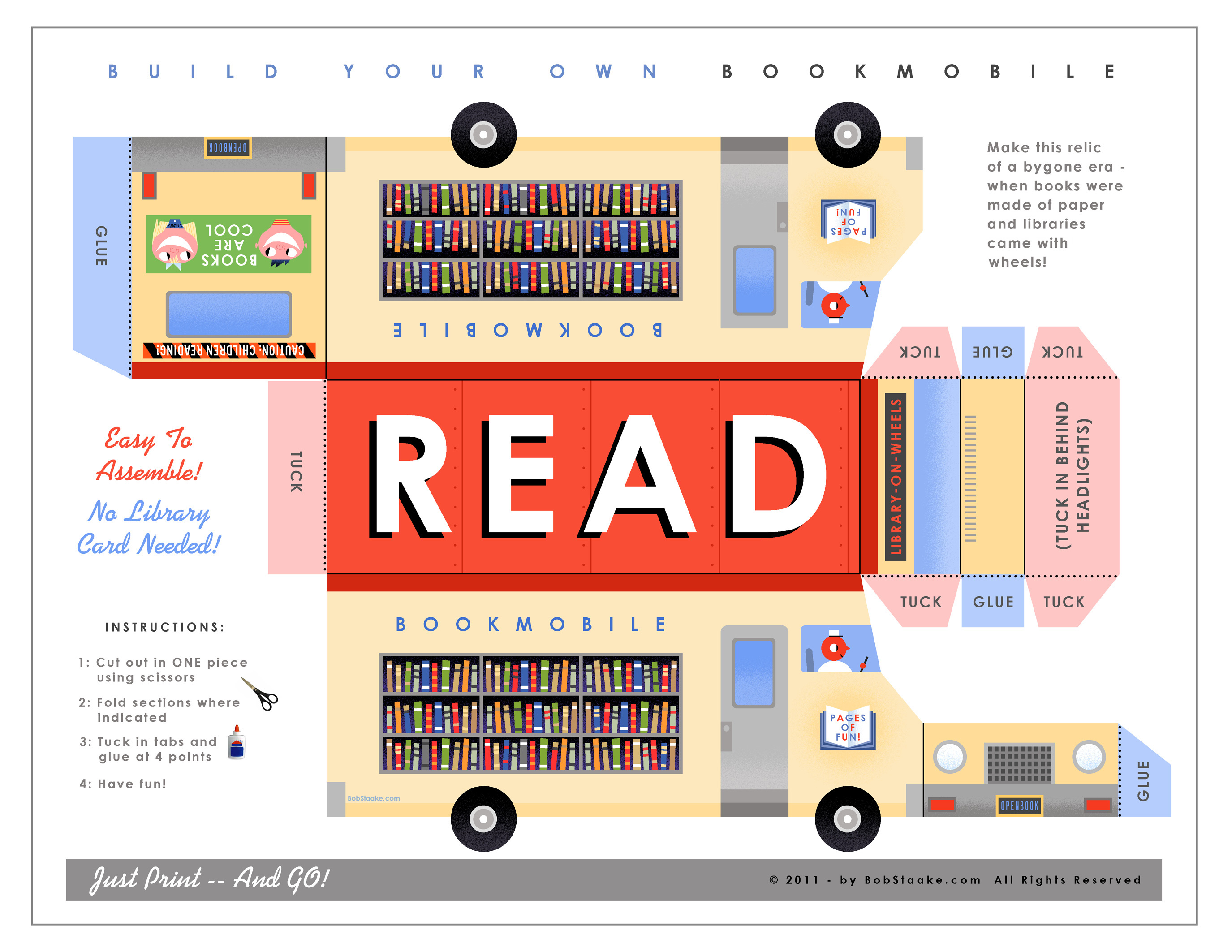
  • Printable 3-D paper bookmobile (hey, whaddya mean, "relic of a bygone era?" Maybe for readers of the New Yorker, Bob, but we're still on the road where there is a need!)
  • In case you didn't like that paper bookmobile, here's another.
  • "Project Sophia Mobile Library--Books without borders for post-conflict children in Indonesia" via the Peace and Collaborative Development Network
    "The Sophia mobile library is basically a library in a vehicle, moving from village to village. The library vehicle, which also known as “the magic box,” contains storybooks for children and teenagers, textbooks, drawing books, stationaries, puzzles, origami, Indonesian children's movies, and children's songs." One of its objectives is to "open a space for intensive and massive communications across generation between various ethnics and religions which allow dialogue to occur and in the end would contribute to the joint effort in building peace."
  • "Bookmobile driver shares joy of books on route," via the San Francisco Chronicle
    "She chats up the students, stokes their enthusiasm about new titles (" 'The Great Rabbit Rescue' comes out in December!") and at one stop reads a spooky Halloween story, "Bone Soup," out loud to the children. Most are the children of ranch owners and ranch workers; Jones knows each one by name. Jorge, a fifth-grader, is hooked on the Percy Jackson series, which retells Greek myths. Megan, a sixth-grader, is big in 4-H and searching for books on chickens [....] In the summertime when kids are not in school, we have 10 ranch stops. It keeps the kids reading for the summer, which is really important. We also get some of the single men who work on the ranches, and some of the moms take advantage of the materials to learn English."
  • "The Lumberjack's Boxcar Library," via Exile Bibliophile
    "Beginning in 1919, this railroad boxcar was refitted to be a library on rails to serve the mobile timber camps in western Montana [....] It was in use into the late 1950s as a library by the Anaconda Company. After that, it was used by the University of Montana at one of their lumber research stations-- first as a library then as a dormitory. It was later used for storage, until it was discovered by the museum and acquired for restoration and interpretation of the timber history of the region."
  • "Baldwin County's Bookmobile: Library on Wheels," via Alabama Live
    "Bookmobile patrons include [people at] retirement centers, retirement homes, assisted-living facilities, day-care centers, public and private schools that do not have an adequate library, the Association for Retarded Citizens, and some stops that are literally in the middle of nowhere. In remote areas, like Hubbard’s Landing north of Stockton, the Bookmobile stops at a fire station, post office, store or community center. Use of the Bookmobile has grown over the years," and the community now has 48 stops.
  • "Our libraries deserve your 'yes'," via the Pittsburgh Post-Gazette
    "We lived in one of the more obscure suburbs of Philadelphia then, and there was no library. But the library came to us in the Bookmobile. The Bookmobile was the coolest vehicle ever, a building with a steering wheel. When I was 3, if you had offered me the choice of someday driving a Ferrari or the Bookmobile, I would have snubbed the overgrown Matchbox bauble and gone for the literary bus."

Seen reading on OC Transpo


  • something by Nicholas Sparks
  • a comic book! I was cranning my neck to see what it was, but decided not to risk life and limb. It was exciting, though, and it made me think - that was the first comic book I have seen. Clearly I don't hang with the right crowd on the bus.
  • something by Ernest Hemingway (it was blue-ish and I am hoping it was Across the river and into the trees, my all-time favourite Hemingway, but I suspect it was the over-prescribed The old man and the sea)
  • Me: Peter Nimble and his fantastic eyes by Jonathan Auxier (CLA BOYCA reading)

Sunday, October 30, 2011

RSC Annual Symposium: Where have the books gone? Reading in our Public Schools, with Heather Reisman

I was blown away by Heather Reisman’s presentation, even though I already knew a bit about the Indigo Love of Reading Foundation, and I certainly knew about the (mostly sad) state of school libraries in Canada.

Reisman outlined the beginnings of the Foundation, when she visited Church St. School in Toronto in 2003. “What I discovered when I opened the door,” she said, “took my breath away.” There were lots of shelves, but few books; the books they did have had an average age of between 18-30 years old. School budgets, Reisman learned, were so tight that purchasing textbooks, toner for the photocopiers or even Band-Aids for nursing stations was proving a challenge for schools. The principal of the school, Judy, admitted it was “all she could do to maintain her half-time librarian and make a few acquisitions in a school year.” For Reisman, who learned to read at age 3 ½, this was unbelievable. She immediately invited Judy to Indigo and told her to buy everything she needed. Judy came, accompanied by students and teachers; none of the children who came to the store that day had ever been to a bookstore before. With these new acquisitions, Judy described to Reisman how the school “went from being a sad place, to being the absolute hub of the school.” Reisman added, “the overall energy of school changed, and student performance and test scores for Grades 3 and 6 improved.

This was the impetus for Reisman to establish the Indigo Love of Reading Foundation. Her work with the Foundation has “opened her eyes to the extent to which we are failing the economically disadvantaged children of this country” and “the extent to which we undervalue teachers and educators.” As Reisman observed, we are systematically widening the gap between haves and have nots; schools in wealthier areas are able to organise fundraisers to provide materials for their school libraries, whereas schools in more impoverished areas cannot do this. “You can't bake sale your way out of this problem!,” declared Reisman. Children at these schools are also doubly deprived, as they are the children more likely to not have books in their homes, either.

Reisman concluded by re-iterating that, if nothing else, “enlightened self interest should make us want to tackle this problem,” since a 1% increase in the average literacy rate of Canadians could generate a 2.5% growth, up to 18.4 billion Canadian dollars in additional money in the Canadian economy. "In my world, we would day this is a very high return on a very small investment," Reisman concluded.

Reisman showed us several excellent videos about the Foundation’s work, with other statistics about early literacy, education, poverty, and student success (38% of Grade 3 students are failing reading; in the 1970s, school library budgets provided for 3 books per child per year, whereas now they provide for less than 1/3 of a book per child per year). One video is online here.

Friday, October 28, 2011

Seen reading on OC Transpo


A slow week this week, books-on-the-bus-wise. On Monday, I was happily given a lift, and otherwise the week seems to be a blur. Plus, you know, OC and I had a bad day on Wednesday, when in the morning the 97 was so far back in the line of buses at Mackenzie King that I missed it, so my commute was 9-95-116-98 (thanks for that!) and then in the afternoon, the 9 just plain didn't show at Hurdman, leaving me there freezing my toes off for 30 minutes. All this after I had actually left work early/on time for once and was looking forward to a hour's uninterupted reading at home alone. Grr. And on Friday, I enjoyed a really lovely walk to Main. OK, anyway....

Thursday, October 27, 2011

Dr Jeffrey Turnbull: Addressing the Social Determinants of Health in a new Health Care Environment

Dr. Turnbull's talk last week at the Desmarais Building was the first in the University of Ottawa's President's Lecture Series. Dr Turnbull spoke to a full house of physicians, scientists, University faculty, students and stragglers like us. No surprise there.

I have been very impressed with Dr. Turnbull's work, especially at the Ottawa Mission, and was eager to hear him speak. Since his topic was the social determinants of health, and given that he serves the same population we sometimes see in the Library, I thought it would be valuable to hear his impressions and recommendations. This post is therefore a bit outside the scope of this blog in some ways, but very much not outside the scope in others: one of my primary interests has always been Library outreach to marginalised populations. You'll see that several of Turnbull's points below have implications for libraries: how can we appropriately (and best) support the health of all people in our communities through our collections, services and programs? With the below in mind, why not ask them?

Dr. Turnbull structured his talk around the "Top 6 ways to stay healthy:"
  1. Don't be hungry:
    In a country in which 868 000 Canadians use the food bank every month, many live great distances from a grocery store (on foot), many cannot afford fresh fruits and vegetables (see Ottawa Public Health's "The Price of Eating Well"), and those living in shelters may not have access to a kitchen to make their own meals, proper nutrition is still a tremendously large problem.

  2. Live in a nice community:
    There will be 1000 people sleeping in shelters in our city tonight. Very shortly, the shelters will begin putting out the mattresses in chapels, hallways and washrooms for the night; it's only October and they are already doing this (it's not even winter yet!). For those who do have a home, 3.1 million of them cannot afford their housing, and another 1.3 million are living in subsidised housing. There is a 21 year difference in average life expectancy between the poor and the rich; in cramped shelter quarters, it's easy to see how infections and illnesses can be spread quickly.

  3. Get a good education:
    There is a 25% illiteracy rate in the poorest bracket of Canadians; there is a 31% illiteracy rate on reserves in Canada. For more information, see ABC Canada's Adult Literacy Facts and a 2006 CBC News Indepth report. As CBC says, "Nearly 15 per cent of Canadians can't understand the writing on simple medicine labels such as on an Aspirin bottle, a failing that could seriously limit the ability of a parent, for example, to determine the dangers for a child." And as ABC Canada observes, "Literacy proficiency improves chances of employment, builds self-confidence and enables discussions and actions that affect the welfare of individuals and their community."

  4. Get a good job:
    6% of Ottawans don't actually make enough money to live in Ottawa. Many are living on the poverty line, or below it, while supporting their families.

  5. Get good health services:
    21% of homeless people in Ottawa shelters are HIV-positive; 80% have Hep C (for more general numbers, see Ottawa Public Health). There is a higher risks of contracting disease in Ottawa shelters, and in many of our poorer areas; in fact, the incidence of TB is lower in Bangladesh than it is on some Canadian reserves.

  6. But above all else, be wealthy:
    "The commodity of your wealth is your health," Turnbull says; "Money can't buy happiness, but it can certainly buy your health." In fact, the biggest predictor of health is your economic status.
So what are the implications of the above Top 6 list, and the attendant issues in Ottawa, for health care?
  • Isolation = social stratification. There are increased risks when people are crammmed in confined spaces together, resulting in diferential exposure of certain groups... We act surpsied when there is higher incidences of illness among certain populations, but isolating those populations together has increased the risks for them.
  • The idea of health care as a public service: This is one way of "levelling the playing field," but is it sustainable? The current health care system was not designed for the 21st century: it was designed on an acute care model, except now we see increased needs for chronic care, and increased numbers of chronic care patients. Observes Turnbull, "we use the chronic care sector as the default for meeting acute care needs."
  • Accessibility: ever waited for lab results? It takes awhile, and that's in an urban area, never mind in a rural area or on a reserve. Compared to other first world countries, "we are a bottom-of-the-pack perormer," despite high spending on health. In fact, health spending gobbles up funding that could perhaps better be routed to preventative measures, such as improving social or educational services, which would in turn improve health ("I just put myself out of a job"). As Turnbull phrased it, "healthcare is the monster eating everybody's lunch!"
  • The CMA wants to mobilise Canadians to "press for transformative chaneg to Canada's healthcare system," including 5 pillars of change: "building a culture of patient-centred care, providing incentives for enhancing access and improving quality of care, enhancing patient access across the continuum of care, helping providers help patients, and building accountability at all levels."
  • Our Canadian emphasis on equity of access to and delivery of health care expresses our values, ensures human rights are protected, and saves money (for more information about the economic consequences of health inequality, see "The economic burden of health inequalities in the United States").
  • We should thus shift this debate away from a conversation about providing charity towards a conversation about protecting the rights of citizens (who are entitled to protection, as enshrined in law and with respect for their human rights).
  • The outcomes of treatment in this manner include improved compliance, appropriate use of medical services (hospital, EMS), and a 64% reduction in risk behaviours, including substance abuse.
Dr. Turnbull spoke about the Ottawa Inner City Health program (of which he is co-founder and Medical Director). You can read a full history of the group here, but as Turnbull explained, it was born out of concern that, while many homeless people were using health services on disproportionate levels, their health needs were still not being met. The co-founders began to ask, what about other related services that the homeless clients might need, such as judicial and social services, etc?

As Turnbull concluded, Canadians can "do better," can serve homeless and marginalised groups better. The model that he envisions is to make the services a homeless person receives "equal to what an individual family would get in their home." It is our collective responsibility to advocate for health equality by advocating for "informed social policy decisions, effective health delivery systems for prevention and care, anti-poverty measures, direct health care services, and positive social change through healthy public policy."

I was fortunate to have a chance to speak with Dr. Turnbull after his talk, and let's just say we have a possible partnership up our sleeves......

A great event.

Miranda Hill fan club

(file under - I think I'm going to start one)

Hamilton writer and Journey Prize finalist, Hill is guest editing The Afterword all this week. Two recent pieces of interest:
  • "Reading here," about her creation of Project Bookmark Canada: "One day, I realized that my walks were covering the same ground as the books I had been reading. I felt that I was stepping into the stories, and my experiences with the books and with the places were suddenly and forever altered."
  • "Since you asked…," about breaking down the subtexts in the question she commonly gets about what it's like to be married to Lawrence Hill (yeah, that Lawrence Hill). An excerpt: "How do you put up with all those moods and pouting? If a plumber storms around and is generally miserable to his wife and children, we call him a jerk. We don’t say, “You’ll have to excuse him. It’s all because of his plumber’s soul.” And plumbers don’t get to say, “There’s only room in this family for one plumber, and I’m it!” Thus, writers who do this are also just jerks. Happily, I’m not married to one of them. I hope Larry isn’t either."

Tuesday, October 25, 2011

Peter Behrens @ the Ottawa Public Library

I wish authors visited my library every day to do readings on my lunch hour.....

I was at my Bookmobile office this morning, but had to scurry back to Main Library for a meeting this afternoon. When I realised that if I left a bit early, I could get to Main in time for Peter Behrens' reading, I was thrilled. My office at Main is just on the other side of the back wall of the auditorium, by the way; knock in Morse code next time you're visiting.

With my crazy week last week (I am working on a couple of posts about it, including hearing Dr. Jeffrey Turnbull talk about the social determinants of health, RA in a day, as well as the International Festival of Authors!), I was happy to catch not one but two Writer's Fest events here in Ottawa on the last day of the Festival (right by the skin of my teeth, eh?). As this post auto-publishes, I will be on my way down the street for the Ottawa Book Awards Non-Fiction Roundtable with Tim Cook, Charlotte Gray, Roy MacGregor, Lawrence Martin and Eric Enno Tamm.

But Behrens... First, what can I say, he is completely captivating. Two lovely colleagues from Westmount Library had been trying to convince me to attend his talks there, and I couldn't quite grasp what the fuss was about, but he's a great, great speaker... and I say that as someone who has heard about a million introverted librarians and authors speak (badly) before! He's self-depracating (buy this book, and if my kid doesn't get into a Canadian university and we have to pay for an American one, the money will send him to university for one minute!), warm, thoughtful (to the point of being, frankly, intense) and has a wonderful deep voice.

Behrens explained that his desire to delve into family history was sparked when he thought about his relationship with his grandfather, and his relationship with his grandfather (upon whose life The O'Briens is based). As Behrens phrased it, that's only "two handclasps" away from history. He spoke about the tradition among earlier generations to keep their feelings and emotions private (they weren't "the Oprah generation"). As they understod it, your truest feelings were the ones you keep inside. Observed Behrens, "now, we hink we have found this new way of being warmly human," and that this privacy is unhealthy, when it is "more complicated than that."

Behrens spoke about the first time he saw the Black Rock in Montreal (I remember the first time I saw it, too: like Behrens, I was in a car, driven by my father, who explained what it was; Behrens observed his grandfather make a gesture to protect himself from the "juju" of the Rock). Behrens described how the "Irish established the template for how immigrants are received" in 20th century North America. The most interesting part of his talk, I felt, was his discussion of how history is treated in art (he talked about either books or films). "What bugs me about historical movies and books," he said, is how sometimes it seems as though "time happened with a different light around it." Artists portray the past in a fuzzy, rose-coloured light, as though it was "unclear," a sort of foreign country. Speaking about people in the past, he said, "I believe they were like us." He hopes historical novels, instead of placing the past at a distance, "take you by the hand and pull you into the world."

Saturday, October 22, 2011

RSC Annual Symposium: Early Innovations and Initiatives in Literacy for Citizenship

A week ago, I had the pleasure of attending the Royal Society of Canada's Annual Symposium: Literacy and Citizenship in the 21st Century, at Library and Archives Canada.

I will post more notes about other sessions later, but one of the first sessions was one of the most fascinating. James H. Morrison, a Professor of History at Saint Mary's University, and Board member and College Historian for Frontier College, presented about "Early Innovations and Initiatives in Literacy for Citizenship." We have a partnership at the Ottawa Public Library with Frontier College: they deliver homework help sessions and reading circles at numerous branches.

Here is my summary of Professor Morrison's fascinating talk.

Professor Morrison opened by sketching several vignettes of his early involvement with Frontier College. During the 1960s, when there were protests on his university campus and students were developing their “social conscience,” Morrison began working on a rail chain gang on the Prairies. He decided to hold evening classes for his fellow workers, tacking up a sign on a rail car that classes would be from 7-9 pm in the evenings. Over the summer, he helped his coworkers work on citizenship applications, or letters to sweethearts.

Morrison described Frontier College’s humble beginnings, from an "idea conceived in protest." Founder Alfred Fitzpatrick’s concern for the transient working class, who were “neither sheltered by unions nor cared for by management,” led him to want to help these unrepresented people. Morrison drew a vibrant picture of the “transatlantic migration of human machines” in early 20th century Canada (between 1881 and 1891, 1 million people came to Canada): the “new world welcomed new immigrants via steam trains,” as politicians (Morrison specifically mentioned Clifford Sifton) promoted immigration as an attractive prospect. Many were destined for work camps or farms: in 1900, the majority of the Canadian population was rural, and the labour class lived outside urban settings. Fitzpatrick took this fact, and the concept of adult literacy, to “rail workers, shanty men, and miners,” beginning in 1899, “bringing education to the men, not the men to the education.” His early efforts “in the wooden wilds of Ontario, were an experiment, intended to demonstrate what Fitzpatrick believed the state should be doing. Fitzpatrick believed that “as long as one man wanted to learn, and another man was prepared to teach him, education would take place.”

Morrison shared many wonderful archival photos of Frontier College’s early work, including farm workers’ classes in the 1950s and today (see one pic above, and others of their lobby display here). The College now works in urban “frontiers”: while they continue their rural work, they also have classes in prisons, low-income areas and have classes for Aboriginal and other marginalised populations. This is in keeping with their history of ensuring that all are welcome: classes have seen waves of Eastern European immigrants in the early 20th century, Aboriginal workers mid-century, and Jamaican and Mexican farm workers in modern times.

Morrison attributed Frontier College’s continued success to four important concepts that the College has learned along the way:
  1. Innovation: Frontier College adopted the concept of the “labour teacher,” had some of the earliest travelling libraries, and were one of the few organisations sending teachers to the unemployment camps in the 1930s. In modern Canada, they were one of the first to hold camps for Aboriginal populations.
  2. Continuity: In its 11 decades, the College has only had 7 presidents. The College has maintained a constant ideal, also: that “literacy is the means by which citizens can enjoy equal rights and equal career opportunities.”
  3. Commitment: Frontier College has maintained a commitment to assist those who have fallen between the cracks of society or “slipped through the twine of the social safety net.”
  4. Youth: The passion, energy and dedication of youth have been crucial to the College. Committed young people with a civic conscience can influence change for the better in the world in which they live.
One of the interesting audience questions after Morrison’s session inquired about Frontier College’s relationship or link to union organisation. Morrison replied that Frontier College was developing long before unions had any influence or power, and also, really, migrant workers (who were the clients of Frontier College) were entirely unrepresented. Frontier College’s opinion was always that their students “can read Lincoln or they can read Lenin... Politics is not the point. We can't tell them what to read!”

A wonderful session full of interesting historical context for adult literacy programs in Canada.

Friday, October 21, 2011

Seen reading on OC Transpo


Tuesday, October 18, 2011

"A ride-along with Ottawa's Bookmobile"

I had a great time last week hanging out with Katherine Dunn, a student in Carleton's School of Journalism and Communication. She's a big fan of Murakami and Hornby, and we both had issues with One Day, so we got along well!

Check out her interview with France and I for CKCU's Week's End radio show here.

I really, really, hate my recorded voice. I sound, um, 12.

Monday, October 17, 2011

Guest post: Honouring F. R. Scott in Montreal

My mum kindly reported back from the Evensong held last week in the Writers' Chapel at the Church of St. James the Apostle, Montreal, to honour Montreal's own F. R. Scott:

"Truly wonderful, inspirational service last night: beautiful music, beautiful setting (the church was gleaming), most interesting talks by Desmond Morton and Roderick Macdonald, current F. R. Scott Professor of Constitutional and Public Law. Macdonald read some of F. R. Scott’s poems and talked about Scott’s legal decisions, his work in the NDP party (a membership he had to give up in order to become Dean of Law at McGill), and Scott's views on the War Measures Act.

The speakers were introduced by Mark Abley, part-time editor at McGill-Queen's University Press, who told a great story about a colleague at McGill-Queens, who undertook a PhD. in History because, at age 11, she was so inspired by a public lecture that Desmond Morton gave at Missisauga Public Library, to which her mother took her."