Showing posts with label conference archive. Show all posts

Monday, November 26, 2012

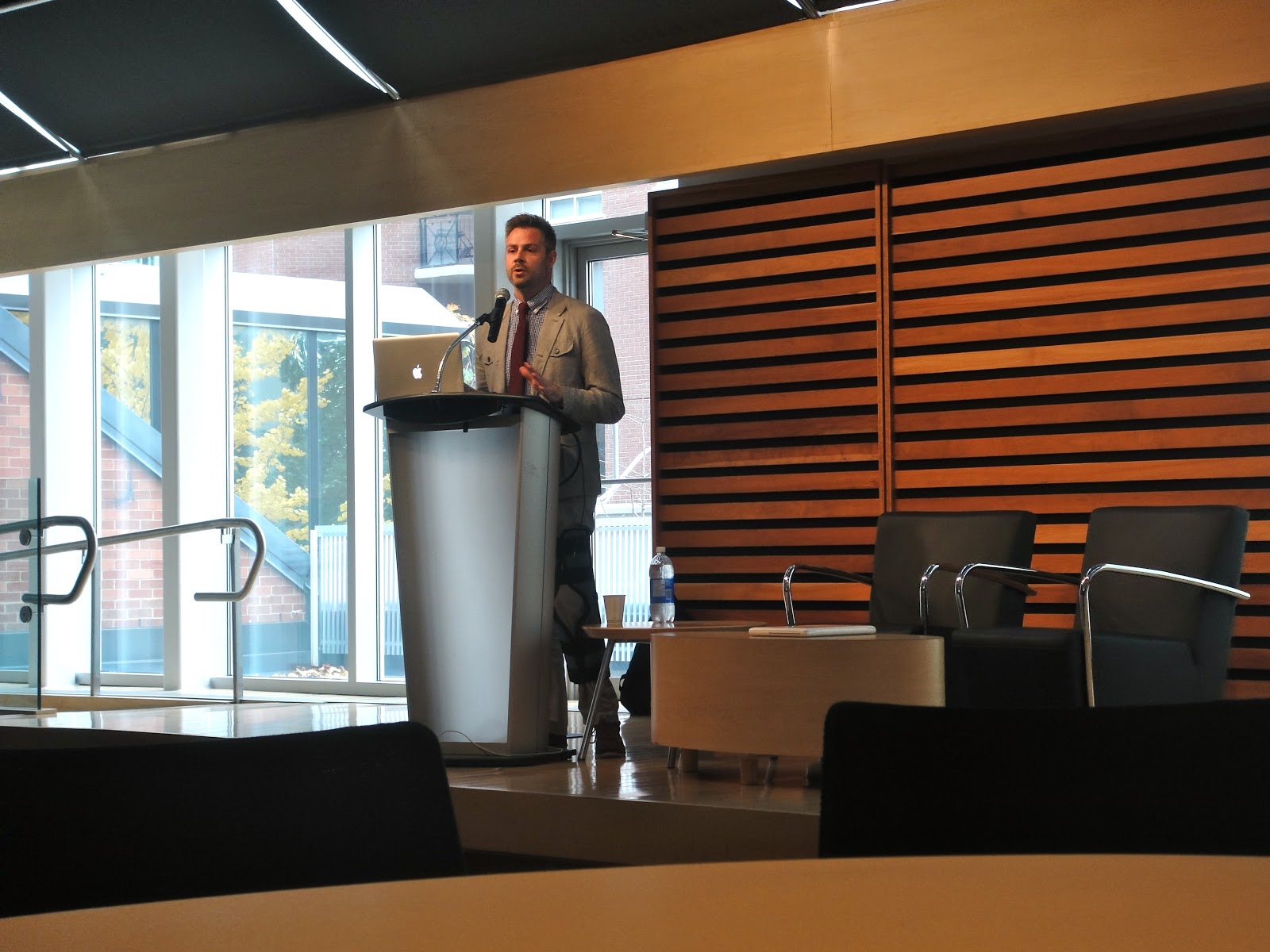
RA in a day 2012: Keynote speaker: Patrick Brown, Community Manager at Goodreads.com


Keynote speaker: Patrick Brown, Community Manager at Goodreads.com

Patrick was an engaging speaker who outlined using Goodreads for readers advisory, either as an individual (inputting your books and using their “Recommends” feature for your own tastes) or as a library (creating an account for your library: Patrick cited Salt Lake County Library as an example of creative use of group space on Goodreads. There are many other libraries on Goodreads as groups, not to mention, ahem, librarians!).

Speaking about the importance of readers, and librarians who are readers, in the online environment, Patrick reminded us that “people want to connect with people, not brands.” In other words, your library may have far fewer friends than you expect on Facebook, in part because the online environment, and the experience of reading and sharing reading experiences, is about personal connection.

Patrick’s talk really brought us full-circle to Sandra Martin’s talk this morning, highlighting the importance of readers in the online environment, and the ways in which readers are reaching out online to one another to create community. I didn't take a lot of notes for this session - by the end of the day, I wanted to sit back and enjoy listening!

Some other interesting things happened at RA in a day. Most importantly, congratulations to my good friend Shonna Froebel, who is the 2012 recipient of the OPLA's Award for Leadership in Adult Readers' Advisory. Here she is with OPLA RA committee chair Sharron Smith.


We also had several great poster sessions around the room, including Oshawa Public Library and CNIB - Book Club Guides, Mississauga Public Library - Readers to Writers at MPL, the OLA Forest of Reading®, and a poster made by me about the OPLA RA Committee Core Competencies (read them! use them!). There were also wonderful vendor displays from LibraryBound, Random House Canada, Penguin Canada, HarperCollins Canada, and the OLA Store. 

Friday, November 23, 2012

RA in a day 2012: The role of fiction and reading in community-building


The Role of Fiction and Reading in Community-Building with Dr. Raymond A. Mar, Associate professor of psychology at York University.

This was a follow-up to Dr. Mar’s 2010 presentation at RA in a day (see notes). In 2010 he talked about narrative fiction as a “simulation” exercise: when reading a novel, for example, you imagine what it would be like to be in the book. With neural imaging, the areas of the brain that deal with social processing light up when subjects are reading. We develop socially when we read, absorbing complex social information in a format that is easier to understand, and there is a correlational relationship between reading and decoding social information.

In his talk this year, he expanded on his research and examined the role of reading fiction in community development (tying into our theme for the day). He outlined recent research his team has done which as found that the genres people read matter; in fact, their study showed that the two genres that best predicted social abilities were (somewhat surprisingly to many) romance and suspense/thriller. Dr. Mar proposed that the former can be perhaps explained by the fact that all romance is about social abilities, social context and relationships.

He also explored the idea of “embodied cognition,” and its relation to reading: even abstract thought (i.e. when reading about an experience) is rooted in perception/action in the brain. Just thinking about a character’s activities, for instance, will activate the areas related to these actions in the motor cortex. In other words, Dr. Mar said, “experiences were akin to reality.”

Reading also predicts more egalitarianism and reduced gender stereotyping; a reader is “forced” to take the character’s point of view in order to understand and inhabit the story, and he or she thus develops empathy. As always, Dr. Mar was a really fascinating speaker.

Wednesday, November 21, 2012

RA in a day 2012: Luncheon Speaker Deborah Harkness


Luncheon Speaker: Deborah Harkness

Deborah Harkness, author of the bestselling novels, A Discovery of Witches and Shadow of Night, was a great speaker: passionate, funny, interesting – you can tell she teaches! She enthralled us with background information about her novels, including the fact that Ashmole 782 is a real manuscript, and it is really missing. She told us “it’s the only alchemical manuscript I ever called up and wasn’t able to get.” Matthew Roydon is also a real historical figure, and she herself is most similar to Emily, not Diana (as many people often assume). She talked about how her students, who she sees at a time of great change in their lives, influenced her portrayal of Diana: “I teach a lot of talented young people who are desperately afraid of their own power.”

Deborah also told us about how the idea for the novels was born: she was on vacation with her parents, recovering from academic responsibilities that left her out of touch with pop culture. When she spotted a copy of Breaking Dawn in the airport bookshop, her parents had to explain the series to her. Her first thought was “what do vampires do for a living?” She mused that they would want a career with some longevity, but not in proximity to, say, blood. So, a geneticist might be an idea… Similarly, a witch would make a good historian, for example. She also outlined the structure of the series: while the first book was set in the present day, the second was more historical fiction, and the third will have more science-fiction aspects to it (she hinted about genetics).

Finally, Deborah talked about using her newfound fame and fortune for good: she observed that the ability to “have an opinion” was cool. “No one cares about what a history professor thinks about libraries,” she explained, referring to media coverage of library closures in the US and UK,” but now that I’m a novelist, well, yes, thank you for asking, I have a lot of opinions about that!” She made a room full of librarians happy when she told us of her early literary influences (including The Witch of Blackbird Pond, one of my childhood favourites), and the quality time she spent in libraries as a child. “I’m here talking to you,” she told us, “because you were here for me when I was little.”

Monday, November 19, 2012

RA in a day 2012: Getting Your Community Reading: Sharing Your Successes

This post is about the second session of the day, Getting Your Community Reading: Sharing Your Successes. 

As a member of the RA Committee, the host organisation of RA in a day, I chaired one of the table discussions during this session. From the committee’s perspective, we developed this session as a response to feedback from previous years: attendees wanted more opportunities to talk to one another. My fellow committee member designed this session so that delegates changed places and sat at a table named for an Evergreen-shortlisted title, everyone brainstormed and shared great programs at their libraries, and then each table presented their favourite adult reading program with the room.

At my table, we heard about:
  • Mississauga Library System’s outreach efforts and Bingo game with literary genres (read them all to fill your Bingo card and win prizes!). 
  • TPL’s Film Club, arts and history lectures, book clubs (including in Cantonese!), bulletin board with patron suggestions (we’re trying this at Carlingwood this month! Come in to the Adult Info desk and leave us a suggestion for a display we are building) and the Thought Exchange series. 
  • Kitchener’s One Book, One Community program, and their participation in Word on the Street.
  • Milton Public Library’s memoir-writing workshop for seniors, Lifescapes (see photos from their book launch). 
  • Haliburton County Public Library’s “Chair yoga” for seniors, and their Shakespeare Club. 
  • Vaughn Public Library’s Teen Summer Reading Challenge. 
  • Someone (I forget who) had a GREAT idea about soliciting book recommendations from high-profile community members (eg. the manager of local business, councillor, school principal, etc). 
I asked the table about their “favourite” failures, and one library (I forget which) shared a story of a Book Club Boot Camp outreach program ("we’ll come to you, and help you design your book club") that didn’t have many takers in the community. We then talked about how marketing / program promotion happens at each library:
  • Some wished they had a Marketing department, but several others at the table concluded having one was often a mixed blessing. 
  • At Kitchener, the Marketing department takes care of travel costs and arrangements, etc. for speakers, as well as promotion. 
  • We talked about paying for advertising in community newspapers (some do, some can’t). 
  • Word of mouth is always the best way to promote a program: invite people who have their own network! Also, people trust their friends but may not trust/know us. 
  • One library faxes programs to the management of apartment buildings and gardening centres in the area.

Saturday, November 17, 2012

RA in a day 2012: Online Book Clubs

The 7th annual "RA in a day" workshop for adult readers' advisory wrapped up recently. This year, we had a theme, which was "Reading Builds Community," and the day was once again hosted in the lovely Bram & Bluma Appel Salon of Toronto Reference Library.

As vice-chair of the hosting group, OPLA's Readers' Advisory Committee, I was fortunate to not only attend, but get to participate in planning and delivering the day's events. Over the coming week or so, I will share some notes from the sessions.

Today, we'll start with our first session, Online book clubs, with Sandra Martin from The Globe and Mail, and Margaret Elwood, the Book Buzz Librarian at Toronto Public Library.

Sandra Martin (standing) and Margaret Elwood.

Margaret spoke first about Book Buzz, TPL's virtual book club. She outlined some of the preliminary research done in an initial survey, showing that book club members are generally 98% female and 88% retired (therefore likely over the age of 65). Book Buzz was an attempt to attract active, engaged adults under fifty (via anonymous participation, no formal meetings), and avoid the book club stereotype. Current Book Buzz members (of which there are 1281) are 84% female and 64% are under the age of 50! There is still high interest in reading fiction, but also non-fiction, mystery, and biography. There is a moderate interest in sci-fi/fantasy, graphic books. The original Book Buzz researchers also looked into other active, successful online book groups, and found that successful ones had an active facilitator/moderator, so they made this a core focus of the site. Book Buzz currently uses Web Crossing software as a platform, but Web Crossing will soon be discontinued, and they will be moving to a social network type of site within the year.

Margaret spoke quite movingly about how the online book club forum broke down barriers: they had teens participating, and one deaf person. Book Buzz, she said, “places no constraints on accessibility.” She also discussed participation inequality at length – the idea that 1% of your participants will post regularly, but many others will find significant value in reading other people’s posts.

Sandra spoke about the Globe’s recent foray into online book clubs, calling 2012 “the year of living experientially” after she was asked to be the online book club facilitator. Sandra, a long-time book lover and member of the Quadrangle Society’s book club at Massey College, was approached by the Globe about an online book club. This was framed within attempts to “entice people to read the Globe online,” a “corporate imperative.” The online book club now uses ScribbleLive.com to host the site. Interestingly, Sandra said that Globe staff thought people would want to read non-fiction rather than fiction (she credits this to journalistic bias!), but of course many book clubs are the opposite. So far, the book club has featured Half-blood blues by Esi Edugyan, Prisoner of Tehran by Marina Nemat (in part because of the Canada Reads controversy), summer picks, and The casual vacancy by J. K. Rowling. Books are chosen by popular vote via a poll on the website. Sandra’s favourite aspect of an online book club is “feeling like I am in a really good conversation and knowing I don’t have to drive anyone home.”

Monday, June 18, 2012

Heard at CLA 2012

Here are some snippets from other sessions I attended at the recent CLA Conference.

From Tina Thomas's session, "Making a Lasting Impression: Building our Brand in our Branches" (Tina is the Director, Marketing and Fund Development, Edmonton Public Library)
  • Clutter is an ergonomic issue for the mind
  • Do your dislays make it look like professionals work there?
  • Can anyone run a program or do circ? Then why can everyone and anyone make a sign?
  • Do you have a signage problem?
From the Great Debate:
  • Why did Occupy make their own libraries? Maybe bc ours close at 5
  • Slacktivism! Petitions are what the powerless people do....
  • Access is not equal to, in one province, a fee. In one national library, an appointment.
  • Put your meat on the table. If you are a professional, show your face.
From the Book Awards's acceptance speech by Matthew Forsythe
  • "Illustrators and freelance artists have to spend one or two days a week at libraries to nourish what we do!"
During Battle Decks, from the lovely Robyn Stockand:
  • "Librarians are innovators in some of the best and all of the worst ways."

From Christina Neigel, Instructor, University of the Fraser Valley, during her session, "Inclusiveness and Hypocrisy: How Do Libraries Really Measure Up?"
  • What about instituting a minor in library studies? Think: if people knew more about our profession, wouldn't that benefit us?
  • "We need to be more outspoken about what it takes to work in this field: you have to want to engage in conflict."
  • "Libraries do not do a good job of supporting lifelong learning within their own walls"
From Evan Solomon at the closing keynote:
  • "The only way around the political philosophy is to be a political strategist."

Sunday, June 17, 2012

The Big Society and UK Libraries: Lessons for Canadian Libraries with CILIP president Phil Bradley

I had the great pleasure of introducing CILIP President and avid blogger Phil Bradley for his session at the recent CLA Conference in Ottawa. His talk focused on the current political situation in the UK, as it affects public library service, but I also learned a few random fun facts (such as
Edinburgh is the first library to develop an app!
).

As you likely know from reading this blog, the current horrifying state of UK libraries is a topic very close to my heart. Much of what is happening over the pond should serve as a warning to Canadians, especially Canadians who love their public libraries. Phil's passion for them was evident in his speech, and his final words were quite moving. Here are some of Phil's quotes and facts.
  • At the moment, 600 libraries in the UK are under threat, of which 262 have been threatened or closed since April 1st 2012 alone. This is out of a total of 4612 libraries in the UK. This is round 1 of the government cuts. Check out the map.
  • "We are very closely associated with one of the artefacts with which we work (the book) and that is causing us problems as that artefact becomes less important over time. Thus the librarian becomes less important as the library becomes less important." We need to distance ourselves from the artefacts. "No one sees a brain surgeon and says, "Oh, of course, scalpels! They say, "Oh, you make people feel better."
  • The UK has a variety of associations serving library workers. CILIP alone has over 16, 000 members, and views itself as a charity and not a trade union. "There are therefore limitations on what we can do and say."
    Sidebar: this issue of the role of a professional association in a time of government cuts ran through a few sessions at the conference, and unofficially spoke to the situation at the opening keynote speech.
  • There are 150 public authorities in England responsible for public library service.
  • All professions are under attack in the current British government's "Big Society:" Police officers are to be replaced by community police (with limited powers, resources, or training). Doctors will have more control over budgets and deciding where to send people (therefore spending more time administrating than doctoring). There will be a higher tax on the teaching profession: more and more are leaving the profession because they find themselves in difficult financial positions and will get more $ elsewhere.
  • There are 44 local campaigns to save libraries. Check out the main page for these campaigns here.
  • Phil's advice to those seeking to advocate or work within the political machine: "You have to be crystal clear about what comprehensive and efficient means or what any of your terms mean. Or what "open" means." For instance, in Essex, the government statement was that "we're not closing anything." The local library's opening hours, however, were cut drastically.
  • "Previous success makes you less likely to change in the future. If you always do what you've always done, you'll always get what you've already got."
  • "The idea that libraries are a good thing is worth nothing."
  • One of the recent developments in high-level advocacy includes a Libraries All Party Parliamentary Group. The Libraries APPG "provides MPs and Lords with information and opportunities for debate about the role that libraries play in society and their future," and has a Conservative MP as its Chair.
  • "Signing petitions shows how powerless you are"
  • "The more strident we become, the less we are able to advocate on the highest levels and discuss libraries instead of library closures."
  • We have to ask ourselves the difficult questions. Here are some of the difficult questions on the table right now for CILIP and UK libraries: Campaigning or advocacy work? What should be our relationship with Friends groups and their campaigns? What is the role of volunteers and what is a volunteer? (Is volunteering really job substitution?) Hospitals or libraries? (Or is this a false analogy?) Do we retrench and do the same things we've always done, or do we do it better, or do we look at new options for libraries? Are fewer bigger libraries better than more small community libraries? What is the role of eBooks and social media for UK public libraries?

Monday, June 11, 2012

The CLA Conference in pictures

So many experiences to distill into a bog post! I am working on some notes from a few sessions I was able to attend despite Local Arrangements Committee duties and THE PLAGUE, which descended on me on the day we were stuffing the bags and doing conference prep. Basically, I spent the first half of the conference with a fiery throat and no voice, and the second half hawking up crap and still unable to talk. Good times.

Anyway, I did manage to have a lot of fun, too:

We stuffed bags.

A LOT of bags:


I am so lucky to have the best team in the history of the world, and two of them, Laura and Helena, created this colour-coded master schedule for the volunteers at the conference. Genius.

Opening keynote:


Delegate feedback to opening keynote:


Laura and I getting silly with the room decorations in Local Arrangements Committee office

Screenshot from Tina Thomas from Edmonton Public Library's great presentation entitled Making a Lasting Impression: Building our Brand in our Branches (this slide = "Do you have a signage problem?")


Here is the first thing I learned at the Great Debate: masks kind of totally scare me.

In other news, the debate was awesome. The topic was “Be it resolved that the core values of modern librarianship areantiquated and obsolete,” and Stephen Abram, Robin Thiessen Hepher, Mike Ridley and Andrea Siemens nailed it with an examination of whether we actually live our values. Some choice quotes:
  • "Why did Occupy make their own libraries? Maybe bc ours close at 5."
  • "Slacktivism! Petitions are what the powerless people do."
  • "Access is equal to, in one province, a fee. In one national library, an appointment."

I hung out with my NELI ladiez.


I was star-struck by Kit Pearson. As Megan phrased it so well, it is such an honour and a privilege to grow up reading someone's books, and then be able to give them an award!

Ryerson's Chief Librarian Madeleine Lefebvre kicked it at Battle Decks. Here, she is explaining how a certain gait will make you more flexible, and allow you to, um, innovate.

This was my favourite Battle Decks slide, noting the intersecting area as "Shitty movies."

A more serious post is forthcoming, but I will leave you here with Vin.

Wednesday, May 16, 2012

Hot sessions @ CLA


Today is two weeks exactly before the conference starts, at the Ottawa Convention Centre. Aside from running around like a crazy person with a 2-way radio doing Local Arrangements, here are the events/sessions I am hoping to make it to (ambitious, I know, considering.....):
  • Wednesday night opening reception (duh)
  • Thursday 9 am: Opening Ceremonies & Keynote Speaker Daniel J. Caron, Deputy Head and Librarian and Archivist of Canada and Chair, Heads of Federal Agencies. Oh yes. That should be interesting..... Caron is also doing a "Hot Topic" at 1 pm, but I think I'd rather be at the below instead. I would imagine both sessions will be colourful if there is some audience involvement. These are some crazy times.
  • Thursday 1 pm: Community Impact: Transforming Lives through Libraries ("how public libraries create programs, advocate to stakeholders, and determine measurable outcomes") with some peeps from Gale.
  • Thursday 4 pm: The Great Debate (always entertaining). This year, it's Michael Ridley and Stephen Abram debating "Be it resolved that the core values of modern librarianship are antiquated and obsolete."
  • Thursday evening, I am triple-booked (thanks for that!): NELI alumni reception, Book Awards, and the pub crawl. We'll see if I last until the crawl....
  • Friday 10:30 am: Tag... We’re It! The World of Interlibrary Loan. I feel like I should be there so I can learn more for my students next year ....
  • Friday 1:30 pm: Getting your Library From Good to Great with my old friend Lita Barrie, now the Chief Librarian of the Grimsby Public Library ("Explore how to help your library thrive in these times of change and uncertainty. Gain practical strategies on making the most of the resources you have to take your library from good to great.")
  • Friday 3 pm: No More Excuses! with Nancy Dowd from NoveList. I have no excuses for not being there because I am convening. I love Nancy's blog, so I am really psyched about this session ("This presentation will show you how ingenuity, a bit of technology and the belief that libraries matter to communities can conquer all the barriers stopping you from getting the word out about what your library is doing.")
  • Friday evening: either chillin' with Lora and my peeps or grazing at the all-delegates social. Or both. Or neither.
  • Saturday 8:30 am: CLA BATTLE DECKS! I want to cheer on Megan Fitzgibbons, OPL's own Beth Goslett, Robyn Stockand, Melanie Sellar, and OPL Board member Christine Langlois, all friends of mine! I know the best peeps.
  • Saturday 1 pm: The Big Society and UK Libraries: Lessons for Canadian Libraries with CILIP president Phil Bradley. Again, convening, so gotta be there. Very excited about this one, too, since it's the ancestral homeland and all.
  • Saturday 3 pm: Closing ceremonies with secret crush Evan Solomon.
And here are some other sessions I think are also totally note-worthy, although I might not make it to them. I've excluded hot topics and big issues like copyright, as those ones are pretty easy to find on the CLA website and get a lot of attention:
  • Friday 1:30 pm: Canadian Challenges Survey 2011: Update on Library Resources and Policies Challenged in Publicly-Funded Libraries - always disturbing...
  • Friday 3 pm: Rebuilding the Slave Lake Library: Surviving Tragedy and Lessons Learned.
  • Saturday 1 pm: Evolution and Transformations. "In Autumn 2011, 19 library directors, senior staff, architects and other library leaders embarked on a four-country 22 library tour in Northern Europe and Scandinavia."

Monday, May 7, 2012

ABQLA 2012: Notes on "Opening up: Innovation and Access"

A very, very old ABQLA logo from the archives

Keynote: The Future of the Digital Library with Sarah Houghton

It was pretty cool to meet Sarah in person. She was with us to talk about what the library of the future look like, post-tech revolution and post-budget cuts. Her talk opened with her asking what libraries are today, and what we want them to be. She asked us if money, bureaucracy and political will were no objects, what three things would we do differently in libraries? She pointed out that some of these things we are thinking about right now (in response to that question) are achievable, and some are perhaps even goals we might share with colleagues in the room, if we were to ask them!

Sarah called for us to re-affirm our core library values and be less reactive. Her talk focused on these core values, including:
  • Providing complete and balanced collections and information
  • Ensuring we provide education, entertainment, and self-improvement
  • Research assistance
  • Freedom of information access
  • Information privacy and security
She also spoke at great length about society's "fragmented" modern life, and the implications of new technologies on libraries.
  • Beginning with basics: we need to better communicate the non-book materials we already have! People know that the library has books, and yet what do we advertise often? Books! We don't need to advertise our books! What people don't know about is everything else we have.
  • The modern "device continuum:" it is really difficult to ensure library catalogues will work on and with every device ever created! Things look better/worse or work/don't work on certain devices; however, given the shift in the rate at which people use mobile as their primary access point for data (astronomical), we have to keep up.
  • Touch screens are ubiquitous. Kids don't remember life before touch screens. One great idea Sarah shared was using touch screens (iPads) as end-of-shelf range displays: they can flash the call # range, and then flash an ad for an upcoming program. I thought that was cool.
  • Pretty soon, your data will always be with you (before I even had time to master the Cloud, I guess it's gone?): paint that becomes a touch screen wall will soon be available and will display your data when you walk in the room with your device in your pocket.
  • How will internet TV affect AV collections? There are no online alternatives for libraries (eg. Netflix for libraries). What role does the library have to provide TV in the future?
  • Download vs streaming: we are moving away from "I want to own this movie/album" to "I will accept having access to everything for $10/mo." People won't use all of it but they like to know it's there. So, think about how this would work for libraries: the ultimate in patron-driven acquisition.
  • 3D printing and augmented reality: these have implications for local communities (history, genealogy, or small business) - what your community has that no one else does. When it comes to augmented reality, your library can match the physical reality with the local info from your archives. You can hold your camera phone up and see what used to be where building x used to be. More on this later from Fiacre below.
  • There are implications for our profession when it comes to 'net neutrality: privileging certain data over other data (eg. cheques changing hands, companies deciding to prioritise YouTube traffic over Netflix, photo downloads over video). We need to be aware of legislation regarding these issues.
  • Social media: Many in our communities remain unaware that, as with Facebook, "if you are getting something for free, you are the product."
  • The challenge of digital proliferation is an opportunity for us: it gives us a lot of chances to reach people where they are.
  • Digital collections: user awareness, formats, DRM, owning and leasing models, device support.
  • Information services: we are still the only place where you can ask anything (I don't know how much I really feel this is a core professional value anymore, to be honest. Yes, you can ask anything, and we still need librarians for the in-depth research questions, but I don't think you need librarians staffing public library Reference or Information desks...)
  • Programming: the digital divide and the long tail. In a time of reduced budgets, Sarah suggests libraries focus on the "middle section: the sorta haves" (they have technology, but not tech knowledge).
  • Library websites = ugly gargantuan tower of awfulness. Don't focus on brand names on your website, eg. "Click here for EBSCO...." Focus on function, not brand or category.
  • "Go mobile or go home."
  • Sarah spoke about a great project for free ebooks: The Open Library Data project, from Internet Archive.
  • "Spend some time sitting in your public computer area. I'll give you $20 if your butt doesn't hurt." Oh crap, she's got me there!
  • Sarah told a great story about how weird it was as she was walking out of a concert, and everyone was in line hovering over photos they had just taken five seconds ago. It was odd, but also demonstrated the pride in creativity (look what I made!) and sense of community sharing that is pretty inspiring about our tech society. That is something we can facilitate in libraries: encouraging creation and sharing.
  • Ask the people you serve what would make their lives easier.
  • We are the library. We democratise information and expertise, and there is no more noble goal.
Information Decoration : Mobile Augmented Reality and Libraries with Fiacre O'Duinn

Yeah, this was a bit out of my comfort zone. Fiacre, you're out of my comfort zone! You hear that?

Seriously interesting stuff, though. Here are some snippets:
  • Augmented reality = Combines real + virtual worlds, interactive, 3D
  • Want to see where technology is going? Look at artists (no such thing as failure) and military (more $ than they know what to do with)
  • Donteat.at - "Get a text message when you check into a NYC restaurant that is at risk of being closed for health code violations." Eg. your phone will vibrate and you will know to get out of there!
  • Ground Crew: you walk by a community gardens, and your phone vibrates to ask you to water it. What could libraries be doing with this technology (which is already out there)?
  • GeoLoqi: a way to securely share location data. Beyond that, you can actually send yourself a note for when you visit a particular location in the future.
  • StreetMuseum: Museum of London iPhone app that shows you images of the place where you are standing throughout history.
  • DIY version: Historypin and the rise of the "information flaneur," walking through information in order to experience it.
  • The idea of "information decoration:" the manner in which information is made available is according to what people want. Focus on the information, not the technology. In fact, "good technology isn't experienced as technology at all, because it is meaningfully integrated."
Saying Yes: Building smart libraries by killing fear and getting the job done with Jenica P. Rogers

* some links and images from her talk (similar to a few of her other recent talks) are on her blog here.

Some quotes and paraphrases:
  • "I love the work we do; I just don't love how we do it. We worry too much about offending everyone."
  • "There has never been a time when libraries are not changing. We can't use 'things change' as an excuse to do nothing. This is it. This is our world."
  • STOP the "collections arms race!" In fact, collection size is rapidly losing importance as a measure of a library's worth. "Traditional metrics fail to capture our value to our mission."
Where we stand:
  • "Viable alternatives to the library now exist and boast fastest growth and easiest access."
  • Demand for our traditional services is declining (now, here is where I would link back to reference questions from Sarah's talk.... I would love to see the two of them discuss this...)
  • New patron demands stretch our budgets and our organisational culture.
  • The future of our information economy is with Kickstarter and crowdsourcing. How will our patrons get access to that information?
  • Stakeholder expectations are not keeping up with reality.
  • "We're not acting; we're reacting. We are great crisis managers," but this can be a weakness, too. "We must move past this."
  • "Technology or tools will not save us. They are only as good as the understanding and effort you put into them."
  • It's time for librarians to examine their own fears and start paying attention. Examine the framework (stop focusing on the task work) and focus on advancing our values.
  • Say yes. "What's the worst that could happen? And could I handle it if it happened? Not would I want to, but could I?"

Friday, May 4, 2012

Je me souviens de l'ABQLA 2012


I have returned, with a medal for participating in Battle Decks at ABQLA 2012, but not with a winning medal. A tremendous participation medal it is, though, made from a dear friend's daughter's soccer meal, re-designed by the visionary puppet-master Lora, and executed by the ever-talented Westmount team.

You *can* go home again, but the past is a foreign country, to mix quotes. This week, I ate mashed potatoes with sour cream and cream cheese with my family, ate croissants and talked libraries and art with Ann, ate chicken with chapeaux and talked religion with my mum and Patricia, got my hair cut, transversed the mountain at least four times in a car and once on foot, ate polenta fries (and drank endless gimlets) and talked libraries and shake weights with Care, Shawn, Lora, Fiacre, and Meghan, and ate conference chicken with my Westmount family.

I ate a lot - did you pick up on that? And I ran only once, with The Husband, my hair whipped into a weird mess by the cold Lakeshore Drive wind.

The last ABQLA conference I attended was the 75th, at which I gave a swanky speech at the swanky dinner, speaking after Jack Rabinovitch and before Nicholas Hoare at the Ritz. This time, I was picked up and twirled around by Faith, hugged by former colleagues I miss desperately, pampered by my mum and my Westmount peeps, and reminded of all I love and all I do not love about my hometown and my first professional milieu. I saw so many old friends (from libraries all over the greater Montreal area, and from local vendor partners) and old enemies, and made some new friends (and a new enemy - that's right, F$ck-Acre: ABQLA 2013 knife fight ... IT'S ON). I felt free, and stifled; I was the conquering returning heroine, and the overprepared type-A personality Battle Decks competitor. Good thing your famil(ies) always love you, even when you eat all their food, drink four gimlii, desert them during a conference dinner for another table, embarrass yourself at Battle Decks, and then scurry back to Ottawa!

Montréal, je t'embrasse.

Friday, December 9, 2011

RA in a Day 2011: Serving Readers with Library Building Projects

Our last session of the day was Serving Readers with Library Building Projects: Toronto Public Library, Mississauga Public Library, Ottawa Public Library

I was presenting, so no notes on these sessions. My session was Serving Readers at Ottawa, and here are some of my speaking notes.

I opened by speaking about GASP - a set of standards for graphics, ambiance, style and presentation developed by American consultant Peter Robinson, and first implemented in West Palm Beach Public Library (see here). I talked about how this unifying set of standards was very challenging in a large library with 33 branches, but necessary: it doesn’t mean OPL locations have to have to be cardboard cut-outs of one another, but they do have to be identifiably part of the same family. GASP standards apply to everything from promotional posters and customer service to renovations and new buildings. We implemented some of OPL's GASP standards in several of our renovations, and these proceses relate to serving readers, as part of an over-arching idea of customer service in the library.

In several renovations, for instance, our use of slatwall, the use of angles as well as lines, and our common chair and carpet designs, unified branches with a similar visual style.

In serving readers with renovations, one important element is to emphasise the library as a place of discovery. This was something we really tried to highlight at Rideau Branch, for instance: says manager Philip Robert, “I hope that people can walk around [...] and discover ideas, authors, books, etc. that they were not thinking of when they arrived at the branch.” We created small display spaces/nooks as best we could, within the constraints of the building. These mini-displays creates sense of discovery for patrons throughout branch and allows you to use small collections in small branches for small displays.

Other renovation ideas that directly serve readers and highlight collections include gondolas and tiered shelving. The latter is both less intimidating, and invites people down the aisle if you use the flat top for display – this was creatively used in a Vanier Branch renovation to pull people into a somewhat arhcitecturally awkward space in children's non-fiction).

In terms of overall architecture, creating an unobstructed view of stacks is helpful for readers, and invites discovery, as does effective use of lighting and floor. Floor colours and materials can be fun to play with - for instance, at Rideau we created the "green carpet" runway that both complements the oak ceiling beams (you can't fight your architectural bones) and leads patrons to the Information desk; we also placed alphabet carpet tiles along a whimsical hopscotch-style pathway in the children's section. Adorable seating in the children's section add to the atmosphere: staff are commenting that young families are staying in the children's section longer and more often after the renos at both Vanier and Rideau. "One of our goals was to make that section into a destination point for young families," observes Philip, and it definitely worked!

If you know Rideau Branch, you know we are lucky to have 30 foot ceilings, which invite the kind of spirit of imagination and inspiration that I am hinting at as an overall theme for serving readers with building projects. These windows both allow us to capitalise on a "cathedral" atmosphere and display selections from the City art collection, further encouraging and supporting creativity in the library.

Moving on to Greely Branch of OPL: Greely's previous library was a 946 square foot space in the fire hall; now they have 3000 square feet. Greely is the fastest growing rural village in the City of Ottawa, and, in fact, one of the fastest growing in Ontario. We received $400, 000 each from ISF, and federal and provincial gov'ts for this new build, with the City contributing the remaining costs. Again, here, you can see how we capitalised on small spaces using some of the same techniques as Rideau and Vanier to create spaces for readers: we used angles rather than straight lines, we made a Teen "nook" behind the circulation desk with a special reading bench, and tucked a display space on the other side of the circ desk. We also used slatwall and adjascent windows to create a small adult reading area: a space of quiet contemplation, cut off from the traffic in the branch.

Words of wisdom from Ottawa Public Library managers and staff:
  • Know your natural environment: the way the sunlight streams into those lovely windows at Rideau affected our plans (after the fact). We realised that we had moved the circ desk into the path of direct sunlight, and had to order custom blinds!
  • Win some, lose some: gradual height increases in shelves opens up the area for display and browsing, but you lose precious shelf space.
  • Re-use and Re-cycle: OPL manager Tony observes, "at both Alta Vista and Ruth E. Dickinson, we were able to re-use and re-cycle many pieces of furniture. The end panels of the shelving at Alta Vista were of excellent quality so we refinished them and we re-purposed shelving from the old City of Ottawa archives. Similarly, at Ruth E. Dickinson we are having chairs with good quality wooden frames re-upholstered in flattering new fabrics."
  • Check the latest accessibility guidelines for design (eg. aisles) . In high use public areas, aisles and passageways, a minimum of 1675 mm wide is recommended to allow two persons using wheelchairs or scooters to pass each other easily. 1200 mm width is required to allow one person using a wheelchair and one ambulatory person to pass. Interior barrier-free routes shall be minimum 1100mm wide with a 1600mm by 1600mm turn-around space a minimum of 30m apart. Know the rules before you make your plans!
My final observations came from:

Lawson, Bryan. "Healing Architecture: For a long time, we have supposed that good design will improve patient well-being. Now we have figures to prove it. Bryan Lawson reports on how patient treatment and behaviour improved with new architecture. (Theory)." The Architectural Review 211.1261 (2002): 72+. Academic OneFile. Web. 4 July 2011.

A study was done in a new wing of a hospital, observing patients’ responses to their surroundings. Patients in the newly designed environments gave significantly better ratings to their treatment and thought more highly of the staff treating them, even though in some cases, it was the same people and the same service. The study concluded that there is a direct relationship between people and their environment, and important factors included:
  • the colours of surfaces
  • the temperature of rooms
  • high and airy spaces
  • an environment that appears loved and cared for
It also cconcluded that it is EVEN MORE IMPORANT how the environment mediates the relationships between people:
  • Matters of privacy or how spaces enable people to establish community or maintain personal place.
So, what does this means for us in a library environment? Although library patrons are not as vulnerable (hot/cold spaces, privacy) as hospital patients, there are some ideas here about serving a variety of people with a variety of spaces and options, being aware of how high and airy spaces are inspiring and formal, whereas lower ceilings are cozy and informal, and about noise versus quiet. Think about how people currently use your space: you can prescribe use by changing elements, and you can capitalise on current spaces/touchpoints by targeting areas for specific reader-oriented activities.

P.S. The computer crashed mid-way through my presentation (it was all a bit "Computer says no") and I had to ad-lib the rest with no pictures - the greatest tragedy was people missed out on the owl (slide 19 above).

Most of the other presentations (very visual!) are online:

Friday, December 2, 2011

RA in a Day 2011: The Psychology of Reading Fiction with Dr. Keith Oatley

Dr. Keith Oatley is Professor Emeritus of cognitive psychology at the University of Toronto, and it is due to the hard work of committee member Diana (pictured here!) that he graced us with his presence at RA in a day. His slides are here.

Dr. Oatley has written extensively about the psychology of reading fiction (see here). He opened his talk by describing character in a novel as being made up of both actions and what happens “beneath the surface,” what is visible and invisible. The relationship between the two is what the psychology of fiction is all about. One of the unique things about a novel or a film is that we can be ourselves and another character when reading or watching: this is “the centre of the psychology of fiction. We take the author's instructions and we mentally create the imagined world.”

Oatley made an interesting comparison with the process of meditation: in reading fiction, we insert the intentions of the protagonist into the part of our mind with which we usually make our own plans. In essence, their plans become are plans: we feel our own emotions in the circumstances in which the protagonist finds him/herself. Studies are beginning to show a correlation between reading fiction and empathy: the more fiction you read, the more empathetic you are and the better you are at understanding others. This could be a kind of “expertise” being developed: for instance, if you read a lot of novels about romantic relationships, you develop better skills in these relationships in real life.

An interesting study was done by Oatley and his colleagues in which a “small personality change” (proportional to the emotions felt) was documented by subjects who were given a Chekov story to read, compared to a control group given a nonfiction re-writing of the same story. One might be able to conclude that “the story enables people to change, but it doesn't make people change.”

Another interesting observation Oatley made was that studies have shown, preliminarily, that people who may be “avoiders” of emotional engagement in real life actually feel empathy more strongly in fiction – perhaps fiction can circumvent that avoidance?
Oatley closed with two wonderful quotes:
  • Proust on his books: they allow people to be readers of themselves, not of my book. My book is the “magnifying glass by which I could give them the means by which they read within themselves.”
  • George Eliot on writing: "It's a set of experiments to see what we humans are capable of."

Saturday, November 26, 2011

RA in a Day 2011: Luncheon speaker, Charlotte Gray

I was the convenor of this session, and Charlotte’s “handler,” so I have to confess I didn’t get many notes down! But here are some observations:
  • I had never heard Charlotte speak before, and I was kind of thrilled to discover that she has a very sharp sense of humour.... Speaking about Dawson City in the 1890s, Charlotte deadpanned: “150, 000 people and 3 public toilets: that's what history smells like." She also protested my introduction of her was fulsome....Bah!
  • Charlotte spoke about her most recent book, Gold Diggers: Striking It Rich in the Klondike. Gold Diggers follows the stories of six historical figures who arrive in Dawson City, Yukon during the gold rush. Charlotte sketched several of the characters in her novel for us, including Father Judge, a Jesuit priest, Belinda Mulrooney, who became the richest business woman in town by opening a hotel in nearby Grand Forks, and Flora Shaw, colonial editor and correspondent for the London Times, who crossed the White Pass trail in 1898 and wrote about it; Sam Steele, the head of the RCMP’s Yukon detachment.
  • Charlotte spoke about the fine line writers walk when writing historical non-fiction: as she described it, "I do not invent, I imagine."
  • She explained that the dialogue in her books is what people really said, taken from their diaries and letters.
  • She gave us some great snapshots into her research processes, sitting at LAC reading Flora Shaw’s letters, or consulting the Sam Steele collection at the University of Alberta.
  • Charlotte also gave us an idea of why she began writing historical non-fiction: when she arrived in Canada from England, she expected it to be very similar to Britain, and found that it wasn’t. She described what she called an uniquely Canadian character: an endless landscape, the idea of "the North."

Monday, November 7, 2011

RA in a Day 2011: Keynote: "RA as a Transformative Act"

The keynote address at this year's RA in a Day event was given by the amazing Duncan Smith, creator and founder of NoveList. Here are my notes; his presentation is available here.


Duncan opened by reading a quote and asking us where we thought it was from:

"We will help you find the perfect collection of books for reflection resolution or relaxation."

Sounds like it could be from a library? It's actually from the website of an English bibliotherapist. Duncan first heard about her in an article in En Route magazine (“Geek Odysseys - Book Loving in London: Volume 2 Bibliotherapy”). The bibliotherapist profiled, Ella Berthoud, spoke about the importance of novels at life-changing moments, and how the reading of these novels allows us to come back to world refreshed.

Duncan then asked, what is the nature of readers' advisory work? He proposed the following four core ideas:
  1. To help readers understand what they like
  2. To assist readers in finding more of what they like
  3. To deepen readers’ appreciation of their reading
    (Smith told a story about Jane Goodall explaining in an interview how her interest in animals was sparked by reading about Dr. Doolittle and Tarzan. He also mentioned an interview with Mia Bauer, the founder of Crumbs Bake Shop, who spoke of being inspired to open her own business by Edith Wharton's Age of Innocence: “she didn't want to live a life of regret like Wharton’s characters.”)
  4. To support readers in sharing their reading with others (sharing comments via catalogue)
The true product of readers' advisory service is thus not circulation, or the number of interactions we have with the public, or the number of book groups our library hosts, but relationships:
  • between books
  • between readers and books
  • between readers (creating a culture and climate of sharing that deepens understanding)
  • between readers and books and us!
So where are the readers?
One essential thing that Smith identified that we need for effective readers' advisory services is the readers themselves. Those who use the library just for fun are approximately7% of all users, but account for 24% of all visits to the library. What is missing from their profile is interaction with staff. Stats from major Canadian public libraries show that the majority of people who come in to the library are not interacting with staff. Also, stats show increased placement of holds online, which means readers may not visit in person as much anymore. In the US, we see that typically 87% of holds are placed remotely. “People are searching for things they already know about, not coming in to find out more about other things;” they see the library as “a utilitarian service.”

Being connected

This use of the library as a utilitarian service speaks to a lack of connection to the library, and specifically to the skilled staff. Smith pointed out that above and beyond implications for readers’ advisory service, this lack of connection can also affect library funding, because “people who are not connected don't vote for increased funding.” Staff need to focus on not just saying "Sorry, we don't have that," but on starting a conversation with readers. Smith posed the question of how we are behaving in interactions with readers: “are we being reactive, invitational, suggestive, enlightening (teaching how to use Novelist), anticipatory, contributatory, participatory?”

Building relationships

We might think the world is now dominated by technology, but it's actually dominated by relationships and “social capital,” just in different places. Some modern places to build social capital include: in the library catalogue, on the library website, in the blogosphere, on social sites (GoodReads, Facebook, etc). With respect to social websites, Smith encouraged us to engage in outreach to them: ‘places like Good Reads are full of library lovers. We should be connecting with them!”

What is our value? According to Smith, there are three ways readers' advisory experts add value:
  1. Our professional stance: we talk about the promise or potential of books for all readers, not from a personal perspective (eg. “This book is great if you love 18th century mysteries because...” not “I loved this book because....”)
  2. Our focus on the reader
  3. Our “reflective practice:” our use of well-researched and thoughtful criteria to categorise reading (the appeal factors).
The majority of our users are connected “not with your building or your collection, but with you, the staff. And that's why we can't just sit around.”

Sunday, October 30, 2011

RSC Annual Symposium: Where have the books gone? Reading in our Public Schools, with Heather Reisman

I was blown away by Heather Reisman’s presentation, even though I already knew a bit about the Indigo Love of Reading Foundation, and I certainly knew about the (mostly sad) state of school libraries in Canada.

Reisman outlined the beginnings of the Foundation, when she visited Church St. School in Toronto in 2003. “What I discovered when I opened the door,” she said, “took my breath away.” There were lots of shelves, but few books; the books they did have had an average age of between 18-30 years old. School budgets, Reisman learned, were so tight that purchasing textbooks, toner for the photocopiers or even Band-Aids for nursing stations was proving a challenge for schools. The principal of the school, Judy, admitted it was “all she could do to maintain her half-time librarian and make a few acquisitions in a school year.” For Reisman, who learned to read at age 3 ½, this was unbelievable. She immediately invited Judy to Indigo and told her to buy everything she needed. Judy came, accompanied by students and teachers; none of the children who came to the store that day had ever been to a bookstore before. With these new acquisitions, Judy described to Reisman how the school “went from being a sad place, to being the absolute hub of the school.” Reisman added, “the overall energy of school changed, and student performance and test scores for Grades 3 and 6 improved.

This was the impetus for Reisman to establish the Indigo Love of Reading Foundation. Her work with the Foundation has “opened her eyes to the extent to which we are failing the economically disadvantaged children of this country” and “the extent to which we undervalue teachers and educators.” As Reisman observed, we are systematically widening the gap between haves and have nots; schools in wealthier areas are able to organise fundraisers to provide materials for their school libraries, whereas schools in more impoverished areas cannot do this. “You can't bake sale your way out of this problem!,” declared Reisman. Children at these schools are also doubly deprived, as they are the children more likely to not have books in their homes, either.

Reisman concluded by re-iterating that, if nothing else, “enlightened self interest should make us want to tackle this problem,” since a 1% increase in the average literacy rate of Canadians could generate a 2.5% growth, up to 18.4 billion Canadian dollars in additional money in the Canadian economy. "In my world, we would day this is a very high return on a very small investment," Reisman concluded.

Reisman showed us several excellent videos about the Foundation’s work, with other statistics about early literacy, education, poverty, and student success (38% of Grade 3 students are failing reading; in the 1970s, school library budgets provided for 3 books per child per year, whereas now they provide for less than 1/3 of a book per child per year). One video is online here.

Thursday, October 27, 2011

Dr Jeffrey Turnbull: Addressing the Social Determinants of Health in a new Health Care Environment

Dr. Turnbull's talk last week at the Desmarais Building was the first in the University of Ottawa's President's Lecture Series. Dr Turnbull spoke to a full house of physicians, scientists, University faculty, students and stragglers like us. No surprise there.

I have been very impressed with Dr. Turnbull's work, especially at the Ottawa Mission, and was eager to hear him speak. Since his topic was the social determinants of health, and given that he serves the same population we sometimes see in the Library, I thought it would be valuable to hear his impressions and recommendations. This post is therefore a bit outside the scope of this blog in some ways, but very much not outside the scope in others: one of my primary interests has always been Library outreach to marginalised populations. You'll see that several of Turnbull's points below have implications for libraries: how can we appropriately (and best) support the health of all people in our communities through our collections, services and programs? With the below in mind, why not ask them?

Dr. Turnbull structured his talk around the "Top 6 ways to stay healthy:"
  1. Don't be hungry:
    In a country in which 868 000 Canadians use the food bank every month, many live great distances from a grocery store (on foot), many cannot afford fresh fruits and vegetables (see Ottawa Public Health's "The Price of Eating Well"), and those living in shelters may not have access to a kitchen to make their own meals, proper nutrition is still a tremendously large problem.

  2. Live in a nice community:
    There will be 1000 people sleeping in shelters in our city tonight. Very shortly, the shelters will begin putting out the mattresses in chapels, hallways and washrooms for the night; it's only October and they are already doing this (it's not even winter yet!). For those who do have a home, 3.1 million of them cannot afford their housing, and another 1.3 million are living in subsidised housing. There is a 21 year difference in average life expectancy between the poor and the rich; in cramped shelter quarters, it's easy to see how infections and illnesses can be spread quickly.

  3. Get a good education:
    There is a 25% illiteracy rate in the poorest bracket of Canadians; there is a 31% illiteracy rate on reserves in Canada. For more information, see ABC Canada's Adult Literacy Facts and a 2006 CBC News Indepth report. As CBC says, "Nearly 15 per cent of Canadians can't understand the writing on simple medicine labels such as on an Aspirin bottle, a failing that could seriously limit the ability of a parent, for example, to determine the dangers for a child." And as ABC Canada observes, "Literacy proficiency improves chances of employment, builds self-confidence and enables discussions and actions that affect the welfare of individuals and their community."

  4. Get a good job:
    6% of Ottawans don't actually make enough money to live in Ottawa. Many are living on the poverty line, or below it, while supporting their families.

  5. Get good health services:
    21% of homeless people in Ottawa shelters are HIV-positive; 80% have Hep C (for more general numbers, see Ottawa Public Health). There is a higher risks of contracting disease in Ottawa shelters, and in many of our poorer areas; in fact, the incidence of TB is lower in Bangladesh than it is on some Canadian reserves.

  6. But above all else, be wealthy:
    "The commodity of your wealth is your health," Turnbull says; "Money can't buy happiness, but it can certainly buy your health." In fact, the biggest predictor of health is your economic status.
So what are the implications of the above Top 6 list, and the attendant issues in Ottawa, for health care?
  • Isolation = social stratification. There are increased risks when people are crammmed in confined spaces together, resulting in diferential exposure of certain groups... We act surpsied when there is higher incidences of illness among certain populations, but isolating those populations together has increased the risks for them.
  • The idea of health care as a public service: This is one way of "levelling the playing field," but is it sustainable? The current health care system was not designed for the 21st century: it was designed on an acute care model, except now we see increased needs for chronic care, and increased numbers of chronic care patients. Observes Turnbull, "we use the chronic care sector as the default for meeting acute care needs."
  • Accessibility: ever waited for lab results? It takes awhile, and that's in an urban area, never mind in a rural area or on a reserve. Compared to other first world countries, "we are a bottom-of-the-pack perormer," despite high spending on health. In fact, health spending gobbles up funding that could perhaps better be routed to preventative measures, such as improving social or educational services, which would in turn improve health ("I just put myself out of a job"). As Turnbull phrased it, "healthcare is the monster eating everybody's lunch!"
  • The CMA wants to mobilise Canadians to "press for transformative chaneg to Canada's healthcare system," including 5 pillars of change: "building a culture of patient-centred care, providing incentives for enhancing access and improving quality of care, enhancing patient access across the continuum of care, helping providers help patients, and building accountability at all levels."
  • Our Canadian emphasis on equity of access to and delivery of health care expresses our values, ensures human rights are protected, and saves money (for more information about the economic consequences of health inequality, see "The economic burden of health inequalities in the United States").
  • We should thus shift this debate away from a conversation about providing charity towards a conversation about protecting the rights of citizens (who are entitled to protection, as enshrined in law and with respect for their human rights).
  • The outcomes of treatment in this manner include improved compliance, appropriate use of medical services (hospital, EMS), and a 64% reduction in risk behaviours, including substance abuse.
Dr. Turnbull spoke about the Ottawa Inner City Health program (of which he is co-founder and Medical Director). You can read a full history of the group here, but as Turnbull explained, it was born out of concern that, while many homeless people were using health services on disproportionate levels, their health needs were still not being met. The co-founders began to ask, what about other related services that the homeless clients might need, such as judicial and social services, etc?

As Turnbull concluded, Canadians can "do better," can serve homeless and marginalised groups better. The model that he envisions is to make the services a homeless person receives "equal to what an individual family would get in their home." It is our collective responsibility to advocate for health equality by advocating for "informed social policy decisions, effective health delivery systems for prevention and care, anti-poverty measures, direct health care services, and positive social change through healthy public policy."

I was fortunate to have a chance to speak with Dr. Turnbull after his talk, and let's just say we have a possible partnership up our sleeves......

A great event.

Saturday, October 22, 2011

RSC Annual Symposium: Early Innovations and Initiatives in Literacy for Citizenship

A week ago, I had the pleasure of attending the Royal Society of Canada's Annual Symposium: Literacy and Citizenship in the 21st Century, at Library and Archives Canada.

I will post more notes about other sessions later, but one of the first sessions was one of the most fascinating. James H. Morrison, a Professor of History at Saint Mary's University, and Board member and College Historian for Frontier College, presented about "Early Innovations and Initiatives in Literacy for Citizenship." We have a partnership at the Ottawa Public Library with Frontier College: they deliver homework help sessions and reading circles at numerous branches.

Here is my summary of Professor Morrison's fascinating talk.

Professor Morrison opened by sketching several vignettes of his early involvement with Frontier College. During the 1960s, when there were protests on his university campus and students were developing their “social conscience,” Morrison began working on a rail chain gang on the Prairies. He decided to hold evening classes for his fellow workers, tacking up a sign on a rail car that classes would be from 7-9 pm in the evenings. Over the summer, he helped his coworkers work on citizenship applications, or letters to sweethearts.

Morrison described Frontier College’s humble beginnings, from an "idea conceived in protest." Founder Alfred Fitzpatrick’s concern for the transient working class, who were “neither sheltered by unions nor cared for by management,” led him to want to help these unrepresented people. Morrison drew a vibrant picture of the “transatlantic migration of human machines” in early 20th century Canada (between 1881 and 1891, 1 million people came to Canada): the “new world welcomed new immigrants via steam trains,” as politicians (Morrison specifically mentioned Clifford Sifton) promoted immigration as an attractive prospect. Many were destined for work camps or farms: in 1900, the majority of the Canadian population was rural, and the labour class lived outside urban settings. Fitzpatrick took this fact, and the concept of adult literacy, to “rail workers, shanty men, and miners,” beginning in 1899, “bringing education to the men, not the men to the education.” His early efforts “in the wooden wilds of Ontario, were an experiment, intended to demonstrate what Fitzpatrick believed the state should be doing. Fitzpatrick believed that “as long as one man wanted to learn, and another man was prepared to teach him, education would take place.”

Morrison shared many wonderful archival photos of Frontier College’s early work, including farm workers’ classes in the 1950s and today (see one pic above, and others of their lobby display here). The College now works in urban “frontiers”: while they continue their rural work, they also have classes in prisons, low-income areas and have classes for Aboriginal and other marginalised populations. This is in keeping with their history of ensuring that all are welcome: classes have seen waves of Eastern European immigrants in the early 20th century, Aboriginal workers mid-century, and Jamaican and Mexican farm workers in modern times.

Morrison attributed Frontier College’s continued success to four important concepts that the College has learned along the way:
  1. Innovation: Frontier College adopted the concept of the “labour teacher,” had some of the earliest travelling libraries, and were one of the few organisations sending teachers to the unemployment camps in the 1930s. In modern Canada, they were one of the first to hold camps for Aboriginal populations.
  2. Continuity: In its 11 decades, the College has only had 7 presidents. The College has maintained a constant ideal, also: that “literacy is the means by which citizens can enjoy equal rights and equal career opportunities.”
  3. Commitment: Frontier College has maintained a commitment to assist those who have fallen between the cracks of society or “slipped through the twine of the social safety net.”
  4. Youth: The passion, energy and dedication of youth have been crucial to the College. Committed young people with a civic conscience can influence change for the better in the world in which they live.
One of the interesting audience questions after Morrison’s session inquired about Frontier College’s relationship or link to union organisation. Morrison replied that Frontier College was developing long before unions had any influence or power, and also, really, migrant workers (who were the clients of Frontier College) were entirely unrepresented. Frontier College’s opinion was always that their students “can read Lincoln or they can read Lenin... Politics is not the point. We can't tell them what to read!”

A wonderful session full of interesting historical context for adult literacy programs in Canada.

Saturday, November 6, 2010

RA in a day 2010: OPLA RA Committee 2010 picks

The OPLA RA committee’s picks for the best books of 2010 are online here.

RA in a day 2010: "Putting Readers First: An introduction to the reader-centred approach" with Rachel van Riel

These are my final notes about RA in a day 2010; I am concluding with notes from the first session of the day (sorry for being backwards!)

Our first session, which lasted all morning was "Putting Readers First: An introduction to the reader-centred approach" with Rachel van Riel, the director of Opening the Book. I was lucky enough to have dinner the evening before the conference with Rachel (as well as Sharron from the RA committee and Brittany Bryan from NoveList); we had some fascinating discussions about books and reading, and the reading / library culture in the UK.

Opening the Book is a British company that has worked with every library service in the UK (as well as several in Eastern Europe and Scandinavia) to design, equip (i.e. with furniture) and train employees in “reader-development.” The concept of reader-development involves looking at the psychology of reading; this seemed to become a theme for the day, really, as it was a term picked up later in the afternoon by Dr. Mar (see also). Reader-development involves libraries’ focusing on a reader-centred approach to service, which includes:
  • Increasing people’s confidence in and enjoyment of what they read: says van Riel, “I want to live in a world where no one apologises for their reading!” We shouldn’t be ashamed of our reading, or put our own tastes down; we should be talking about what’s on our bedside table, not what we brought with us to “look good” in public.
  • Opening up reading choices: 80% of the sales in UK bookstores are of less than 5% of the stock. Libraries have a definite strength here: we can offer a much richer diversity of titles, and the “risk” (monetary + disappointment) factor is much less in borrowing from us than in buying.
  • Offering opportunities to share reading experiences: Reading is a bit invisible. Where were you when you finished the last great book you read? It’s likely you were in bed, with the light on, late at night. If someone else is there with you, it’s probable that they are snoring. You are not, for instance, in a sports stadium with 10, 000 other like-minded people, cheering your favourite author or book on! Reading is not like sharing other art forms. Were you to travel into space, however, you might see the world lit up at night by all the lights on from the homes of all the readers, worldwide: we outnumber fans of all other leisure activities.
Van Riel’s session was so informative, and so jam-packed, that I am going to break it down into my own “themes” for clarity of expression here!

Sausages and chocolate bars: concepts behind the reader-centred approach
The reader-centred approach starts with why, how and what people read, how reading fits into people’s lives, and how to promote to readers using motivation and engagement. As van Riel phrased it, “sell the sizzle, not the sausage;” libraries should be selling the experience of reading more than the actual book (eg. what the sausage/book can do for you, not what it is). She says we spend a lot of time choosing our sausages (debating which book to recommend or promote). Often, even, we end up promoting access to the bestsellers, which is counter-intuitive; we “sell” the same top 10 that people see at the bookstore, even though we have a much broader selection, and even when these top 10 are unavailable at the library (due to requests). The real test of the library of the future will be when patrons come in for that bestseller, can we sell them something else? The reader-centred approach should open up reading choices, allowing library staff to escape from genre and author displays, bring books together in unusual combinations, and mix fiction/non-fiction.

Look at the way chocolate bars are marketed, which is pretty stereotypical: there are chocolate bars sold to men, and these campaigns stress energy, protein, etc. There are chocolate bars sold to children, and these campaigns stress fun colours, shapes and textures, or pop culture characters. There are chocolate bars sold to women, and these campaigns stress treating yourself, doing something for yourself, and/or sex. As ridiculous as this is, we could learn something from this idea: the library tries to be “anything aimed at everybody,” and as a result, “nobody identifies with it.” People come into our buildings for 3 minutes, 30 minutes or 3 hours, and we treat them all the same. We should be exploring offering more targeted services to targeted markets.

As an example, van Riel described a pilot outreach project in a cancer treatment centre in Wales. The project was developed after a library employee visited the centre herself. She observed that the reading material provided in the waiting rooms was out of date and tired; moreover, people in the centre for treatment came from all walks of life and various parts of the country, often for up to 8 hours a day. A small library collection was developed for the cancer centre; the idea being that people could read the book while they were there, or take it home to finish and return it to any library in the area. The program was a great success: during the first week, one book from the collection ended up in Anglesey, which was “pretty much the farthest it could be” from the centre. Having the collection also provided a “safe” topic of conversation (eg. other than illness) for patients and staff of the centre.

Display and marketing ideas
Libraries in the UK and Scandinavia have experimented with reader-centred marketing campaigns, design, and programs, and van Riel outlined several in her presentation, including the “Give me a break” marketing campaign in Wales. This campaign was geared towards 18-30 year olds, and the posters completed the slogan: “Give me a break from stress,” “Give me a break from the kids,” or “Give me a break from it all.” The emphasis was on the diversity of experiences of 18-30s: some already had families, jobs and responsibilities, and some were still living at home, students or unemployed, possibly bored. The posters themselves featured images representing these experiences. As van Riel pointed out, book publicity generally shows photos of authors and book covers; where is the reader in all this? By giving readers the starring role in marketing and display ideas, libraries can re-engage with readers, value their individuality, and celebrate what reading means to them.
Other ideas:
  • Take the lead: books to get ahead
  • Take a risk – on a book
  • Bite-sized reads
  • Books about people more memorable than you!
Displays and marketing are key because studies show that people like manageable choices. One study analysed people’s behaviour in an empty parking lot versus a full one. In the full one, people pulled into the first available spot; in the empty one, people changed their minds about their spot many times, often pulling in and out repeatedly. To avoid this dithering, displays are a great tool to spark discussion and help patrons make choices.

Programming ideas
A book and wine tasting event was held at a community library in England. Several countries were represented by a table in the library containing a wine and a novel; visitors sat at that table, and, while they were tasting the wine, listened to a reading of an excerpt from the novel.

The physical layout of a library
Furniture and displays should thus make choices easy; we should also remember that the bestsellers don’t need our help! In children’s departments, van Riel suggested actually connecting books and play (TPL’s KidsStops and OPL’s early literacy spaces do this very well, I think!). Many libaries segregate areas for play and areas for reading - van Riel sees this as implying: “Have fun here; be bored here!” She showed some magnificent photographs of children’s spaces in European libraries, including one library where they had hollow tunnels with custom slatwall on the exterior curve; children were encouraged to pick a book from the slatwall and enjoy it inside the tunnel on a built-in bench.

The library’s online presence
Whichbook.net was used as an example of a dynamic website targeted to readers. The site promoted titles beyond the bestsellers and from independent presses using an online read-alike survey. Reader-friendly websites, van Riel explained, should be structured around users, not the library, should use technology to meet needs that cannot be met online, and work best when they are small and changing, rather than huge and static.

Getting the conversation about books going
Consider using real people and their real statements about reading for a library marketing campaign: one campaign in the UK took pictures of local well-known personalities and put them up around town (eg. the local hardware store would have a photo of the owner). Each photo was captioned, “What is he/she reading? Find out at the library!” In the library, there was a display of books chosen by each personality.

Some other suggestions for engaging with patrons included:
  • Have a spot for returned books. People love browsing each others’ returns. Consider a double-sided book truck, with one side labelled “Recommended” and the other “Not recommended!”
  • Have a “Book of the day” display – one book. If the book is taken out, that person has to choose the next book of the day. van Riel said that in one library where this was done, the book changed practically every 2 minutes.
  • Recommended reading from patrons: write down what people say in their own words. Can be used on small noticeboard with passport-sized photos of readers to accompany text, or large poster on end of bay of books, or on website, local newspaper, or e-mail signature line.
For the next part of her session, van Riel had us break up in pairs (with someone at our table that we didn’t know very well) to discuss the following questions and get our own conversations about books going. The questions below were geared to get us thinking about the experience of reading, and how a conversation around reading habits can easily turn into a conversation about particular book titles.
  1. Where do you read? (places, eg. armchair, bed, staffroom, beach, balcony)
  2. When do you read? (time, eg. time of day, season)
  3. Do you read every page or do you jump ahead? Do you employ different strategies for different types of books?
  4. Do you ever cheat and read the ending first? If so, what are the circumstances?
  5. How far back can you go with your reading memories? (eg. what is your earliest memory of reading or of books?)
  6. What else do you do when you read? (eg. cook, sunbathe)
  7. What did you read as a teenager for the “sexy bits?” (eg. what was passed around class or had well-worn pages in the school library?)
  8. Who do you talk to about your reading?
Final thoughts
Most organisations, van Riel concluded, claim a lot more than they achieve. Libraries, on the other hand, “achieve loads more than they claim.” We should be immensely proud of the fact that we are the most popular voluntary organisation; the most popular organisation that people choose to participate in!

We then took a lunch break. During either break or lunch, a woman from Stratford Public Library (Melanie? Sorry, my memory is terrible!) came up to tell me she was a reader of my blog. That was pretty exciting! She also told me about some wonderful things going on at SPL, and she shared with me a great reading list they made that is set up like a menu, entitled “A taste of the Stratford Public Library.” Categories included appetizers (magazines), entrees (non-fiction), desserts (light fiction), and specials (DVDs and databases), with all titles food-related!